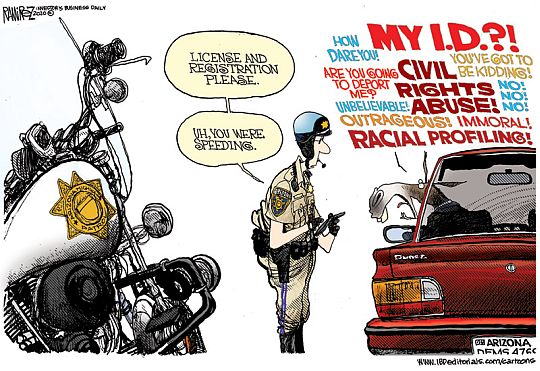
 Governor Jan Brewer of Arizona signed SB 1070 into law last Friday. Predictably, groups that favor relaxed enforcement of immigration laws, including the ACLU and others insist the law is unconstitutional. Even our misguided President declared it “misguided” and said the DOJ would look into the legality of the new law.
Most of the concerns that have been voiced are disingenuous and completely without merit. This is a summary of a rebuttal to those lies published in an editorial yesterday in the N.Y. Times, believe it or not. The author, Kris W. Kobach, is a law professor at the University of Missouri at Kansas City. He served as Attorney General John Ashcroft’s chief adviser on immigration law and border security from 2001 to 2003.
Here are the major points and the rebuttal to each:
It is unfair to demand that aliens carry their documents with them.
The Arizona law simply adds a state penalty to what was already a federal crime. Moreover, as anyone who has traveled abroad knows, other nations have similar documentation requirements. Since the federal laws aren’t being enforced, this provision is necessary and fair.
“Reasonable suspicion” is a meaningless term that will permit police misconduct.
The Arizona law didn’t invent the concept: Precedents list the factors that can contribute to reasonable suspicion; when several are combined, the “totality of circumstances” that results may create reasonable suspicion that a crime has been committed. Nobody will be randomly stopped unless there is this totality of circumstances suspicion.
If a police officer pulls over a minivan for a traffic violation and it is crammed with a bunch of people of any color or race, the officer may have reasonable suspicion that the driver is a ‘coyote’ and the passengers are being transported illegally in a known area of immigrant smuggling.
The law will allow police to engage in racial profiling.
Actually, Section 2 of SB 1070 provides that a law enforcement official “may not solely consider race, color or national origin” in making any stops or determining immigration status. In addition, all normal Fourth Amendment protections against profiling will continue to apply. In fact, the Arizona law actually reduces the likelihood of race-based harassment by compelling police officers to contact the federal government as soon as is practicable when they suspect a person is an illegal alien, as opposed to letting them make arrests on their own assessment.
It is unfair to demand that people carry a driver’s license.
Arizona’s law does not require anyone, alien or otherwise, to carry a driver’s license. Rather, it gives any alien with a license a free pass if his immigration status is in doubt. Because Arizona allows only lawful residents, native or alien, to obtain licenses, an officer must presume that someone who produces one is legally in the country.
State governments aren’t allowed to get involved in immigration, which is a federal matter.
While it is true that Federal authorities hold primary responsibility for immigration, the Supreme Court since 1976 has recognized that states may enact laws to discourage illegal immigration without being preempted by federal law. As long as Congress hasn’t expressly forbidden the state law in question, the statute doesn’t conflict with federal law and Congress has not displaced all state laws from the field, it is permitted. That’s why Arizona’s 2007 law making it illegal to knowingly employ unauthorized aliens was sustained by the United States Court of Appeals for the Ninth Circuit.
In sum, the Arizona law hardly creates a police state. It takes a measured, reasonable step to give Arizona police officers another tool when they come into contact with illegal aliens during their normal law enforcement duties.

 This echinopsis cactus flower appeared in the wee hours during the night. By the time we wake up in the morning it will have wilted. Given such a short open period, it’s a good thing I managed to capture this photo today on the patio.
 Although our move to the Grand Canyon State is not imminent, we have been thinking about the logistics to facilitate our relocation. One relocation requirement is that we register our vehicles with the Arizona Department of Transportation.