The Reptiles Are Back

lizard.jpgNow that we have been in our new home for over a year, we are observing the variations to flora and fauna that take place when the seasons change. Now that spring is a little over a week hence, we see more and more small lizards around the property. I guess they hibernate or become dormant in the winter months. We were walking the dogs today when I spotted this lizard sunning itself on a round rock.

Image: Lizard sunning itself on a round rock. Click to enlarge.

As the weather continues to get warmer, we expect to see a lot more activity from reptiles (including snakes) as well as other critters such as scorpions. We have not seen any snakes or scorpions this spring, but we will be watching for them . . . 😯

Planetary Conjunction

conjunction.jpg

Planets Jupiter and Venus are currently gathered in the western sky as they do from time to time. This evening, I went out with the new camera on a tripod and played around with some of the settings and modes to get this image of the conjunction in the twilight. I took this image using the AV or “aperture priority” mode on the camera. You can see the two brightest objects are Jupiter (left) and Venus. Our neighbor’s illuminated flagpole is visible near the bottom of the frame. Click on the image to enlarge.

New Camera Preliminary Evaluation

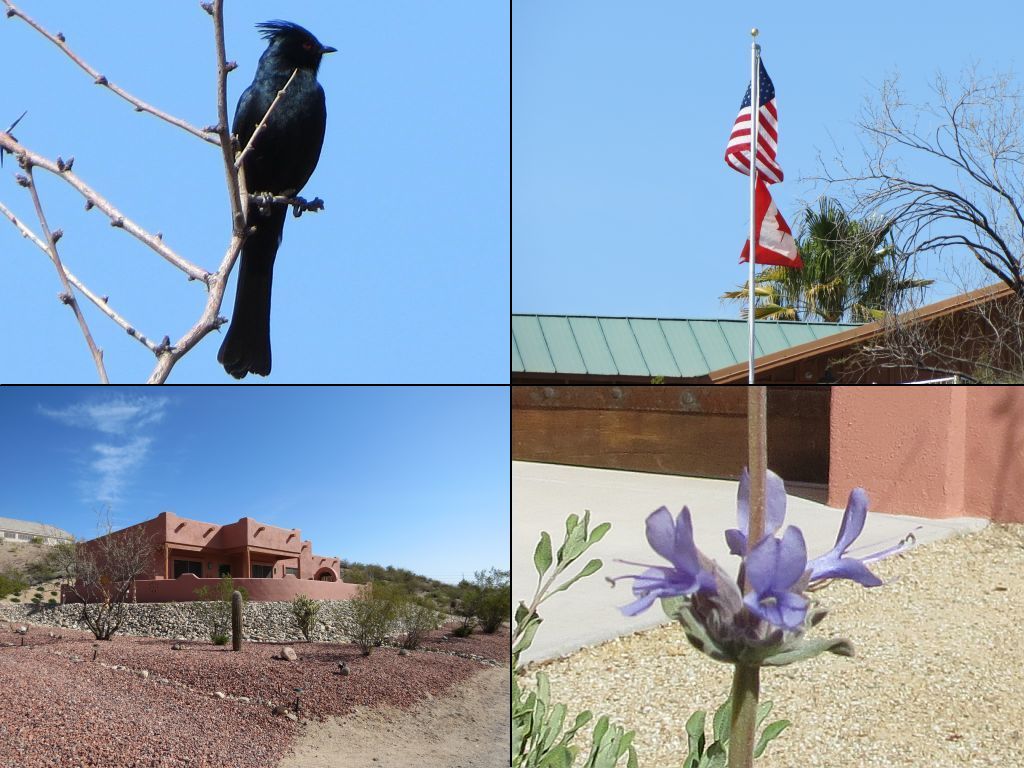
composite.jpgAbout a week and a half ago, I blogged about a new camera I ordered. Yesterday, the post office delivered my new Canon SX40 HS. I unpacked the box last night and followed the getting started instructions this morning.

Image: composite of four photos I took today – click to enlarge.

As soon as I finalized the order last week, I downloaded the users manuals from the Canon website. I browsed through the manual to get familiar with the camera’s controls and specifications which gave me a head start on operations.

So, several times today, I took the camera outside and shot some sample photos. The top left image above is a bird perched in a mesquite tree about fifty feet away. At top right is a neighbors flagpole taken at a range of about 400 feet. Bottom left is a view of the home taken this morning. Finally, bottom right is a Cleveland sage flower I took in the courtyard this afternoon.

I am reasonably pleased with the performance, notably the telephoto images. The image stabilizer works much better on this camera than the old one. Close up photos aren’t usually my thing, but I think the camera performed well on those as well.

Speaking of the bird in the photo above, you may be able to help me identify the species. It is black with white stripes on the bottom of its wings, has a topknot like a jay or cardinal, jumps into the sir like a mocking bird dancing and has a whistle-like call ascending in pitch like a human whistling for a dog to come. You can click here for a large view of this bird. We can’t find it in any of our bird reference books.

Captain Zero’s Stimulus Score

From The Washington Times via John Lott: After receiving $885 million in Stimulus, “D.C. has no count of jobs from stimulus”

zero.jpgDespite receiving more than $885 million in federal economic stimulus funds since 2009, the D.C. government — whose residents face one of the highest unemployment rates in the nation — cannot say how many jobs it actually created for those who live in the District.
Most of the money has been spent, and data suggest that overall regional job growth did occur as a result of the massive infusion of capital. But a review by The Washington Times of figures provided by D.C. officials shows that the city spent hundreds of millions of dollars without being able to demonstrate any significant improvement in the city’s jobs outlook.

Zero Jobs Image Courtesy The Patriot Post

If anything, the employment picture has worsened in the District. At the end of 2011, according to the U.S. Bureau of Labor Statistics, the city’s unemployment rate was 10.4 percent, ahead of only three states: Nevada (12.6 percent), California (11.1 percent) and Rhode Island (10.8 percent). . . .

Adjusting the BP Meds

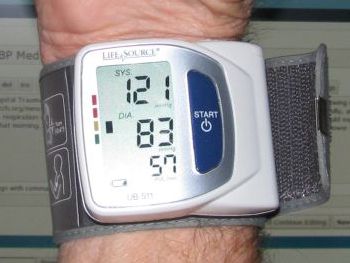
sphygmo.jpgThe Good Samaritan Hospital Trauma Center in Phoenix had me wired up to the vital signs monitor after I was admitted following my Humpty Dumpty experience. Thankfully, all the vitals looked good (heart rate, respiration rate, oxygen levels, etc.) except that my blood pressure was curiously lower than I would expect having not taken my BP meds that morning. Indeed, even after spending the night in the hospital, my blood pressure remained normal or a bit lower still despite having taken no BP meds for the second day in a row.

Image: Wrist band blood pressure monitor showing normal reading

Almost two weeks after the incident, I was at the Community Clinic to have the staples removed. During the visit, the Medical Assistant took my blood pressure. It was quite low – like 97 over 53. The PCP discussed this with me and told me to cut the meds in half. That was a week ago.

I got out my little wrist band sphygmomanometer today and took several readings. The at rest readings were still a little low, on the order of 105 over 65, but with normal activity the readings looked quite normal. I am due to go in for another follow-up next week and will further discuss the readings as well as take my wrist model along to see how it stacks up with the clinic’s sphygmo-whatever.

CO2 Global Warming: Proven or Unproven?

Unproven wins hands-down.

From CO2 Science:

Anthropogenic-CO2-Induced Global Warming: Proven or Unproven?
hyper-stuck.jpg

The fact that there has been little to no net warming of the earth over the past dozen or so years, in almost all of the global temperature databases that are maintained by the various research groups that study this important subject, has led many people to suggest that anthropogenic CO2 emissions are not having the large global warming effect the world’s climate alarmists assign to it. And this fact has led many climate alarmists to devise complex explanations for this dilemma.

On 12 August 2011, for example, Science published Solomon et al.’s contribution to this effort, which begins with the statement that “understanding climate changes on time scales of years, decades, centuries, or more requires determining the effects of all external drivers of radiative forcing of earth’s climate, including anthropogenic greenhouse gases and aerosols, natural aerosols, and solar forcing, as well as natural internal variability.” The result of their effort in this undertaking was the finding that “near-global satellite aerosol data imply a negative radiative forcing due to stratospheric aerosol changes over this period [since AD 2000] of about -0.1watt per square meter, reducing the recent global warming that would otherwise have occurred,” although they emphasize that additional contributions to global climate variations of the past and future decades such as from solar variations, natural variability, or other processes “are not ruled out by this study,” which pretty much means that the study does not mean very much, and that it can thus be forgotten within the context within which it was conducted.

. . .

Clearly, the weight of real-world evidence continues to suggest that it is the recurrent millennial-scale cycling of earth’s mean global air temperature that has been responsible for the bulk of the warming of the 20th century, which could yet continue its upward course, level out, or begin a slow decline; for this phenomenon has created such warmings and subsequent coolings time and time again without any help from mankind. And if it’s done so before – innumerable times, in fact – it can do it again. In fact, it has actually got to be expected that it would do so, and at about this point in earth’s history.

[more]

More Lithops Flowers

I put the pot with the lithops succulents outside the patio where the morning sun can shine on them. All I can say is that they must like it there. These are the three latest flowers produced this early spring. Click on the image to enlarge.

lithops.jpg