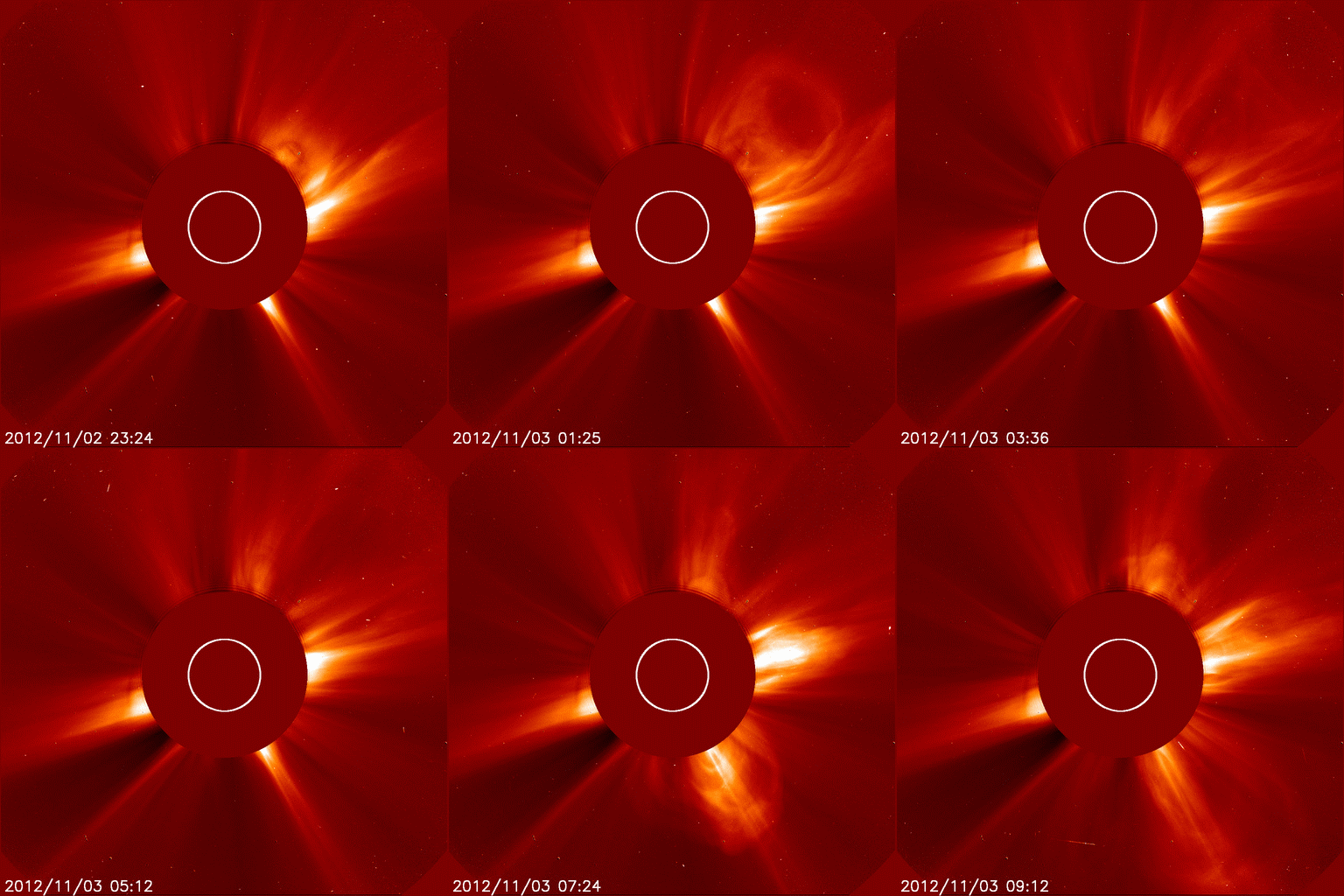
This is a reminder for those who believe that puny anthropogenic emissions have sh*t to do with climate and the environment. Witness the influence of our star – SOL.

This is a reminder for those who believe that puny anthropogenic emissions have sh*t to do with climate and the environment. Witness the influence of our star – SOL.
 I read a scientific study today from CO2 Science that indicates biofuels may be harmful to the atmosphere. It is a well-documented reality that biofuels do not emit less CO2 than fossil fuels as they are purported to do.
Now, there is a scientific paper that suggests biofuels deplete ozone in the atmosphere. The ozone layer protects the surface of the Earth from intense solar UV radiation.
Image: a humorous look at how to put biofuels into your gas tank
The paper notes that nitrogen-based fertilizer used in the production of crops to be used in biofuels, cause nitrous oxide (N2O) to be emitted when burning them. N2O is yet another greenhouse gas that has been known for over 40 years to deplete stratospheric ozone.
The conclusion from the CO2 Science report follows:
In light of their findings, as [the authors] state in the concluding sentence of their report, “increased biofuels production and consumption could therefore be damaging to the ozone layer,” which would be detrimental to the biosphere due to the fact that the stratospheric ozone layer filters out much of the harmful UV-B radiation coming from the sun, which otherwise could do much damage to earth’s terrestrial plants.
I emphasized that last statement to point out the potential vicious cycle of destroying or adversely affecting the crops from which the fuels are made. This whole biofuel debacle is just another example of the liberal “superstition trumps science” untruth.

When Damsel took this photo of one of the cacti in the patio, it reminded me of a post I did back in the dark ages (still working for a living) about the Fibonacci Series:
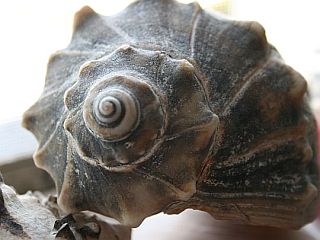 When Damsel snapped this picture of a seashell a couple of days ago, it reminded me of a class I took in school. One segment of this class studied the mathematics of pattern formations in nature. It was interesting to me then and has been interesting since.
The phenomenon of an expanding spiral, as in the photo, comes from a number progression known as the Fibonacci series. The series is formed by starting with 0 and 1 and then adding the latest two numbers to get the next number in the progression. The first Fibonacci numbers are 0, 1, 1, 2, 3, 5, 8, 13, and so on.
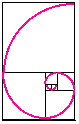 If you stack squares of dimensions in the Fibonacci sequence and connect the base intersections with a smooth curve, you get a spiral that resembles that of the shell. In the diagram at the left, two squares of dimension 1 are located in the center of the spiral, and squares of 2, 3, 5, 8 and 13 are added to the rectangle stack.
A property of the Fibonacci series is that as the series progresses, the ratio of adjacent numbers converges on a quantity known as the Golden Ratio or Golden Section. Golden Ratio comes from a name given by renaissance mathematicians. It was probably Leonardo da Vinci who first called it the sectio aurea (Latin for the golden section). The Golden Ratio appears regularly in arts, in architecture and in nature.
For everything you ever wanted to know about the Fibonacci series numbers and the Golden Section, visit Dr Ron Knott’s multimedia web site.
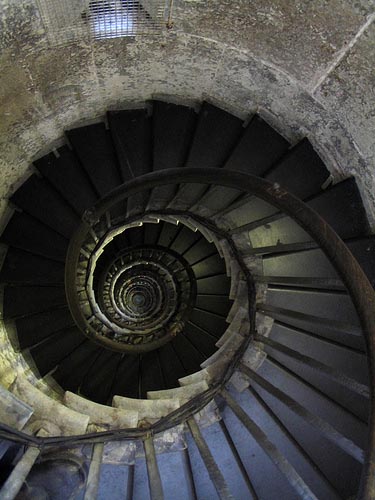
UPDATE Fibonacci spirals in linear perspective: Observe the spiral staircase as it winds into the distance below. I found this picture on a website all about European architecture. I was looking for something else and noticed the Fibonacci connection.
 I had my annual eye checkup today. It was mostly the routine “Which is better – 1 or – 2?” At the end of the exam, the optometrist showed me some information about cataract surgery which, she says, ‘could’ be required at some point.
In the meantime, I still can enjoy corrected vision in the 20-20 or 20-25 range with eyeglasses, of course. I have a set of sunglasses from last year, that work just fine. I ordered a new set of single-vision clear glasses, mostly for watching TV and after dark junkets out with the dogs. I stopped driving at night after I retired.
The interesting thing about cataract surgery is that they can, with minimal invasive surgery, replace the natural crystalline lens affected by cloudiness with a new artificial lens that compensates for both nearsightedness and presbyopia. Of course, there are caveats like astigmatism and muscle range, but it sounds like someday we can get rid of contacts or corrective glasses altogether.

Congratulations to NASA and JPL team for the safe landing of the Curiosity Mars Science Laboratory.
Mission Information courtesy JPL/NASA:
Mission name: Mars Science Laboratory
Rover name: Curiosity rover
Size: About the size of a small SUV — 10 feet long (not including the arm), 9 feet wide and 7 feet tall — (about 3 meters long (not including the arm), 2.7 meters wide, and 2.2 meters tall), or about the height of a basketball player.
Arm Reach: About 7 feet (2.2 meters)
Weight: 900 kilograms (2,000 pounds)
Features: Geology lab, rocker-bogie suspension, rock-vaporizing laser and lots of cameras
Mission: To search areas of Mars for past or present conditions favorable for life, and conditions capable of preserving a record of life
Launch:
7:02 a.m. PST, Nov. 26, 2011
(10:02 a.m. EST)Landing:
10:31 p.m. PDT, Aug. 5, 2012
(1:31 a.m. EDT, Aug. 6, 2012)Length of mission on Mars: The prime mission will last one Mars year or about 23 Earth months.
Image courtesy JPL/NASA. Click to enlarge

I was tooling across the web on Friday at my usual web stops when I ran across this behemoth telescope on APOD. It’s the High Energy Stereo System (HESS) used not for looking into space, but to analyze the light emitted by cosmic rays striking the Earth’s atmosphere.
When I first saw the picture of this 32×24 meter cherenkov telescope I immediately thought of the giant contraption in the film “Contact” where Jody Foster takes a trip to the Vega star system. Click on the image to enlarge.

This is a visual summary of the transit as seen from our Arizona home. Starting at the upper left is the first we were able to detect the silhouette of Venus as it just entered into the solar disc. Although we didn’t observe any disciplined schedule of taking images, we went outside every once in a while and snapped several images.
This is a collage of a dozen images from the first noticeable shadow until after the mid-transit image. Ecliptic north lies at about the 2:30 position in the individual images. Notice how atmospheric attenuation darkens the solar disc in the last three or four images taken as the sun approached the horizon.
Click on the image to enlarge.