
Huge spikes of plasma fly out of the Sun’s surface all the time, according to scientists studying observations made by SOHO and STEREO spacecraft. This week’s SOHO Pick of the Week discusses these spikes in scientific terms, although there is still considerable question as to their nature and effects, especially about how they affect the planets — ours in particular.
I’m thankful for the ongoing study of the Sun. The more we learn about it, the more we will be able to refute the hysterical Greenbat nonsense about man-made global warming .
Breaking News! James Hansen’s Fake Temperature Algorithms
From SOHO Pick of the Week:
A close up view of the top of the Sun as seen in profile shows thousands of little spurts, like small blow torches, shooting out all over the Sun. The movie shows just an average day’s worth of this kind of activity as seen from the STEREO spacecraft (Ahead) in extreme ultraviolet light (August 3, 2007). These spurts are called spicules. With STEREO’s 2048×2048 image resolution and an image every 10 minutes, we can zoom in on features like this with no distortion. Spicules are plasma jets that shoot through the Sun’s atmosphere or corona at about 90,000 kilometers per hour. Discovered in 1877 by Angelo Secchi, they remain largely unexplained, in part because observations are difficult for objects with a brief life (about 5 minutes) and relatively small size (diameters of just 300 miles / 500 kilometers). They are caused by shock waves formed when sound waves at the solar surface leak into the solar atmosphere. More than 100,000 spicules occur at any given time on our star’s surface.
Watch the video below for a dynamic look at Solar Spicules.

 With respect to the temporal distribution of the 30 severe and persistent droughts identified by Narisma et al., seven of them occurred during the first two decades of the 20th century (1901-1920), seven occurred during the next two decades (1921-1940), eight during the middle two decades of the century (1941-1960), but only five during the next two decades (1961-1980), and a mere three during the final two decades of the century (1981-2000), which is not at all what one would have expected if the climate-alarmist thesis that is propounded by Gore and his followers was correct.
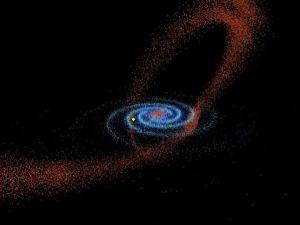 Using volumes of data from the Two-Micron All Sky Survey (2MASS), a major project to survey the sky in infrared light led by the University of Massachusetts, the astronomers are answering questions that have baffled scientists for decades and proving that our own Milky Way is consuming one of its neighbors in a dramatic display of ongoing galactic cannibalism. The study published in the Astrophysical Journal, is the first to map the full extent of the Sagittarius galaxy and show in visually vivid detail how its debris wraps around and passes through our Milky Way. Sagittarius is 10,000 times smaller in mass than the Milky Way, so it is getting stretched out, torn apart and gobbled up by the bigger Milky Way.
  Last weekend when NASA Director Michael Griffin deigned to criticize global warming alarmists by saying “I am not sure that it is fair to say that it is a problem we must wrestle with” – Griffin made his remarks during an NPR radio interview. Afterwards, James Hansen, a scientist, also with NASA, was prompted to describe Griffin’s remarks as “arrogant” and “ignorant.”
  But upon what “science” are Hansen’s criticisms based? Hansen testified before the imperious “Select Committee of Energy Independence and Global Warming of the United States House of Representatives” in April with a tome entitled “Dangerous Human-Made Interference with Climate.” It turns out that much of what Hansen told lawmakers was his opinion, and not tested and peer-reviewed scientific fact.