I was browsing Planet Gore a while ago, when I ran across this provocative Headline:
The Sunspot Recession by Greg Pollowitz.
Pollowitz suggested perhaps the Obama Administration could direct the Treasury Department to print up another trillion or so in currency and rocket it into the sun as a ‘stimulus’ to get the solar cycle moving again – funny.
Drilling down a little more int the article, I found a link to an article comparing the current solar minimum to a Bear Market:
NASA: Sun Gripped by a Bear Market
The sun works on a pretty well known 11-year cycle of activity, all measured by sunspots and solar flares.
There were no sunspots observed on 266 days during 2008, or 73 percent of the time. The last year things were quieter was 1913, which had 311 spotless days. Some observers figured the solar cycle had hit bottom in 2008.
But like the stock market, the sunspot cycle is unpredictable. And just when astronomers thought it had hit bottom, it went lower. It has been a bear market for sunspots for many months now. That also means there have been no major space storms, which can zap satellites and threaten power grids on Earth.
“This is the quietest sun we’ve seen in almost a century,” said sunspot expert David Hathaway of the Marshall Space Flight Center.
But the sunspot recession is not over. Sunspot counts for 2009 have dropped even lower, the space agency announced today. As of March 31, there were no sunspots on 78 of the years 90 days (87 percent).
Solar storms pack charged particles that slam into our atmosphere and, when they penetrate, can cause a cascade of failures in satellites and power systems.
It matters because scientists would like to be able to predict when things will pick up, and when the next “solar maximum” will occur. At peak activity, tentatively expected in three or four years, more and more powerful solar storms up the odds of a satellite failure or a power grid malfunction.
Deep calm was fairly common a hundred years ago. The solar minima of 1901 and 1913, for instance, were even longer than the one were experiencing now. To match those minima in terms of depth and longevity, the current minimum will have to last at least another year.
For more information about solar effects on climate, visit the following links:
Ultimate Global Warming – SPF 2 Million Won’t Be Enough
Correlating Sunspots to Global Climate
Cosmic Rays, Solar Flux and Global Warming
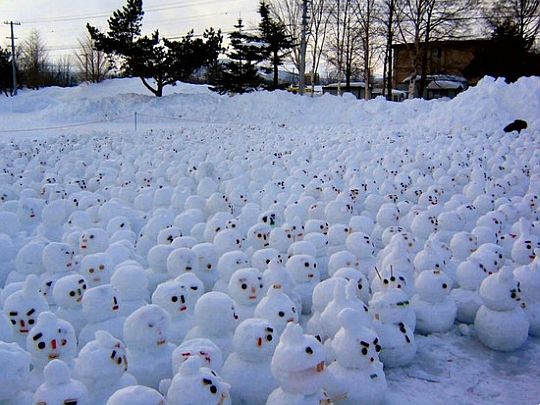
One recent instance of cool weather:
A Snow-Bound Buick
 Leonardo Da Vinci has often been described as the archetype of the renaissance man, a man whose unquenchable curiosity was equaled only by his powers of invention. He is widely considered to be one of the greatest painters of all time and perhaps the most diversely talented person ever to have lived.
 Galileo Galilei, was a Tuscan physicist, mathematician, astronomer, and philosopher who played a major role in the Scientific Revolution. His achievements include improvements to the telescope and consequent astronomical observations, and support for Copernicanism. Galileo has been called the “father of modern observational astronomy”, the “father of modern physics”, and “the Father of Modern Science.”
 Philip Handler, was an American Nutritionist and President of the National Academy of Science for 2 terms. Handler was also a recipient of the National Medal of Science. He also believed that experimental observation, judiciously and honestly conducted, is the first obligation of the experimental scientist and that theory must be compatible with observation, not the reverse.
 John Michael Crichton, M.D., was an American author, producer, director, and physician, best known for his work in the science fiction, medical fiction, and thriller genres. His books have sold over 150 million copies worldwide. As the creator of the TV series ER, most famously as the author of Jurassic Park, and its sequel The Lost World, which were both adapted into high grossing films and leading to the very successful franchise. In 1994 he became the only creative artist ever to experience chart-topping success in America with a film, a television series, and a novel, all at number one simultaneously.