Environment

Alligators in the Sewers Part VII

Here’s an update on our reclusive crocodilian neighbor:

Sun’s out, and so are trappings of spring

The latest in the arsenal to try to catch Harbor City’s renegade alligator, an 8-by-3-foot metal trap, has been left at the shore by Los Angeles recreation and parks officials in recent days, carefully positioned on the far side of Machado Lake amid the thick, floating vegetation.

The trap sits in an area where the alligator, a former pet named Reggie, was last seen in October and is camouflaged, mostly hidden from public view.

[more]

Read our previous alligator articles

The Next Great San Francisco Quake

Wednesday April 18, 1906 – 100 years ago today, a great earthquake occurred along the San Andreas fault, the epicenter of which was quite close to the City of San Francisco. More recently, other earthquakes have occurred in the same area: 1979 Coyote Lake, 1984 Morgan Hill and 1989 Loma Prieta earthquakes. All of these facts are well-known, and aren’t necessarily new news. Not until some recent work that is, by geologist David Wald and associates. The paper, entitled “Source Study of the 1906 San Francisco Earthquake,” compares the events using data from a 100+ year old seismograph that just happened to record both earthquakes.

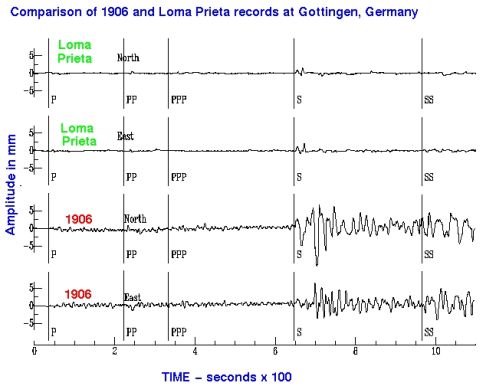
Below – This is the seismogram data showing both quakes:

One great value of old seismographs is that we can make quantitative comparisons of 1906 with the 1989 Loma Prieta earthquake. Fortunately, the same seismograph instrument at Gottingen, Germany was operating during both earthquakes.

If the Loma Prieta (M~7.0) trace looks smaller, it is because the 1906 (M~7.8) earthquake released approximately 16 times more energy:
Because we have much more extensive information about the ground motion that accompanied the 1989 earthquake, we can work backwards and infer what the ground motions must have been like in 1906.

We expect that the shaking in the next 1906-type earthquake will probably not be much more intense than the shaking felt in 1989 near the epicenter of the Loma Prieta earthquake, but it will last longer — perhaps 45 to 60 seconds or more. Strong shaking in the Loma Prieta earthquake lasted only about 15 seconds. In a repeat of the 1906 earthquake, the region experiencing intense shaking will also be much more widespread than in the Loma Prieta event, affecting areas all along the rupture.

Studying the little Loma Prieta pips on the upper traces and recalling the massive travesty that was the 1989 event, makes one wonder how bad it will be if the energy of the 1906 event were to occur today. My estimation is that damage and casualties would be 100 times worse than 1989.

Now, I don’t want to get into predicting the future, but when (not if) this quake happens in San Francisco, and the devastation is on an order of magnitude to compare to New Orleans last year, just watch the weeping, wailing Friscoites blame the administration for everything that happened – that is, unless the administration happens to be a Democratic one.

Paraphrasing the Bard: “What fools these liberals be.”

Click on WikiPedia for more information about the 1906 event.

Global Warming takes a Break

More and more evidence surfaces about the true nature of global warming. Real scientists looking at the hard evidence of the phenomenon, realize that claims of man-made greenhouse gasses causing warming are false.
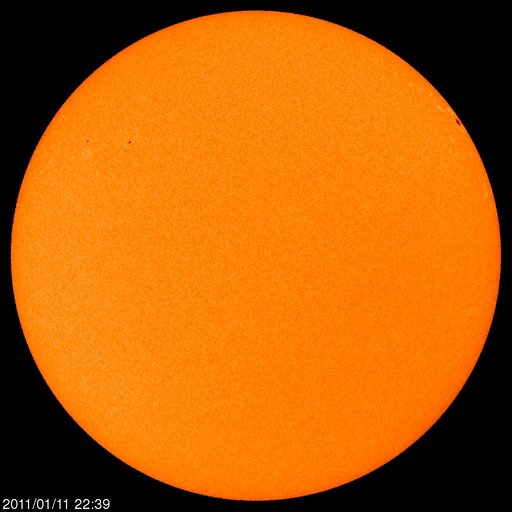
Right: Current SOHO Sunspot Image.

Professor Bob Carter, a geologist at James Cook University, Queensland, who is engaged in paleoclimate research, wrote this excellent article addressing the “Man-made global warming” myth:

There IS a problem with global warming… it stopped in 1998

For many years now, human-caused climate change has been viewed as a large and urgent problem. In truth, however, the biggest part of the problem is neither environmental nor scientific, but a self-created political fiasco. Consider the simple fact, drawn from the official temperature records of the Climate Research Unit at the University of East Anglia, that for the years 1998-2005 global average temperature did not increase (there was actually a slight decrease, though not at a rate that differs significantly from zero).
Yes, you did read that right. And also, yes, this eight-year period of temperature stasis did coincide with society’s continued power station and SUV-inspired pumping of yet more carbon dioxide into the atmosphere.

[read more]

Check out Today’s Eclipse

NASA Shared this video of the solar eclipse today from Turkey. Check it out!

NASA Shares Solar Eclipse With the World
NASA gave people a front row seat to today’s total solar eclipse, thanks to a partnership with the University of California at Berkeley and the Exploratorium. A streaming webcast brought the eclipse — visible along a path from South America to Africa to Asia — to schools and museums and computer desktops worldwide.

VIEW ECLIPSE VIDEOS: + Windows | + Real

The eclipse coverage was part of Sun-Earth Day, celebrated every year to help everyone better understand how our sun interacts with the Earth and other planets in the solar system. This year’s theme, “Eclipse: In a Different Light” shows how eclipses have inspired people to observe and understand the Sun-Earth-Moon system.

Alligators in the Sewers – Part VI

With spring approaching, flowers are in bloom, the mocking birds sing all night long and the alligators come out in Machado Park.

Reggie: Part II is expected to open at lake in April

The original Alligator Tale of Harbor City had quite a cast of characters, including Crocodile Hunter Steve Irwin. The sequel is shaping up nicely.

Rise and shine.

It’s spring. The sun is shining and temperatures are climbing. The days are growing longer.

Can Reggie’s reawakening be far behind?

Harbor City’s elusive alligator hasn’t been seen since October, when a reptile’s normal winter hibernating season begins.

But Russ Smith, reptile curator for the Los Angeles Zoo, says the South Bay’s favorite watery beast should be stirring back to life any time now in Machado Lake, where he’s eluded capture since August after he was allegedly released illegally over the summer by his owners.

“It’s going to be soon,” Smith said of the alligator’s expected resurfacing. “I still think March would be a good possibility, but I imagine the (recent) cold weather probably pushed things back a little bit. It will probably be April now.”

[read more]

Previous articles on Reggie:

Also for your amusement: Reggie not ready for close-up.

More Climate Hype Debunked

World Climate Report takes on the non-scientific hype being put out by climatological extremists in this very good article:

World Climate Report » No News is Bad News

There is not much new in a collection of articles about global warming and sea level rise in the latest issue of Science. As such, it is mostly recycled and repackaged information that the head of the American Association for the Advancement of Science (AAAS), Donald Kennedy, can take down from New York Avenue in DC to Capitol Hill, to scare politicians into doing what it wants, which is an immediate cap on U.S. emissions of carbon dioxide.
Never mind that even a 25% reduction will have an undetectable effect on the rate of global temperature rise in the foreseeable future, and that it will cost a lot. Science crammed its March 24th issue with five articles (including commentary and editorials) devoted to melting ice and sea level rise—including one (Overpeck et al., 2006) which proclaims “[I]t is highly likely that the ice sheet changes described in this paper [leading to an—egad—global sea level a rise of 12-18 feet] could be avoided if humans were to significantly reduce emissions early in the current century” is hardly surprising.

[read more]

Surfer’s Cove

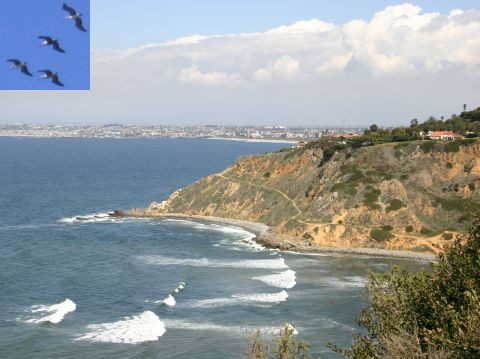
An exceptionally clear day motivated us to drive to the west side of Palos Verdes peninsula today. One of several stops brought us to an overlook of Surfer’s Cove west of Malaga Cove along the coast. A flock of pelicans gracefully soared past as we watched the ocean and listened to the surf.