
November 2008

Firestorm Caused by a Bird?

orange-sun.jpgA Local brush fire is now under control, but not before the smoke nearly blotted out the sun. Fine, white ashes continue to fall here, even after sunset. This is how the sun looked mid-afternoon from the back yard. Click to enlarge.

SoCal Edison blamed the fire on a bird. From the Daily Breeze:

Firefighters mopped up the remnants of a 10-acre brush fire this afternoon that briefly threatened the Rancho Palos Verdes City Hall earlier in the day.

Unlike fires raging elsewhere in Southern California, the one on the Palos Verdes Peninsula was put out quickly. It took about 100 firefighters and two helicopters about an hour to extinguish it, authorities said.

The fire was reported at 11:02 a.m. It burned in a canyon near Hawthorne Boulevard and Palos Verdes Drive South.

“It started to go to the city yard,” said Los Angeles County Fire Capt. Jeff Vroomes. “That was our priority. We made an aggressive attempt to get in front of it.”

No homes were immediately threatened.

Southern California Edison officials determined the fire was caused by a bird that landed on power lines. After being killed by electricity and catching fire, the animal fell into the dry brush, Vroomes said.
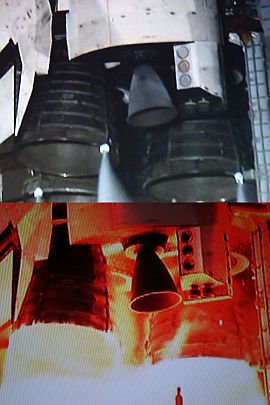
STS-126

liftoff.jpgSTS-126 is on the way to the ISS. Damsel snapped these from the TV before and after engine ignition.

This is the NASA account the launch thus far:

Go for Launch!
Fri, 14 Nov 2008 04:46:20 PM PST

NASA’s mission managers have announced a “go” for launch! The countdown for the STS-126 mission has entered its final moments. Automatic systems at the launch pad will remove the remaining equipment out of the way of space shuttle Endeavour so it can make its climb into space.

Endeavour Soars Into the Night Sky!
Fri, 14 Nov 2008 05:07:21 PM PST

Space shuttle Endeavour roared off Launch Pad 39A at NASA’s Kennedy Space Center on a spectacular tower of smoke and flames. The STS-126 mission is an extremely ambitious undertaking, highlighting four spacewalks and delivering the heaviest payload in shuttle history.

External Tank and Boosters Away!
Fri, 14 Nov 2008 05:09:23 PM PST

The giant orange tank that provided fuel for Endeavour’s climb into space is now empty and is jettisoning from the shuttle. As the tank falls away and descends toward Earth, the tank’s on-board cameras record the process. About two minutes into flight, the solid rocket boosters propelling Endeavour higher into space have successfully separated and gracefully fallen away. Each booster has a parachute packed in its frustum that will automatically deploy after entering Earth’s atmosphere to slow the descent into the ocean. Endeavour has safely attained orbit and NASA mission managers have given the command to proceed with main engine cutoff, also known as MECO. Less than 10 minutes after launch, Endeavour was orbiting around Earth. Within 24 hours, Endeavour will meet up and dock with the International Space Station.

Flight of the Phoenix – Part IV

After nearly a half-year, Mars lander and science robot Phoenix goes silent. I posted about this interesting project in ‘Flight of the Phoenix’ Parts I, II, and III. This is the finale, although there is a very remote chance the robot could ‘phone home’ one last time.

Watch the video to see the Phoenix Mars approach and landing animation (courtesy NASA).

From NASA:

NASA Video – click > to play.

Mars Phoenix Lander Finishes Successful Work on Red Planet

WASHINGTON — NASA’s Phoenix Mars Lander has ceased communications after operating for more than five months. As anticipated, seasonal decline in sunshine at the robot’s arctic landing site is not providing enough sunlight for the solar arrays to collect the power necessary to charge batteries that operate the lander’s instruments.

Mission engineers last received a signal from the lander on Nov. 2. Phoenix, in addition to shorter daylight, has encountered a dustier sky, more clouds and colder temperatures as the northern Mars summer approaches autumn. The mission exceeded its planned operational life of three months to conduct and return science data.

The project team will be listening carefully during the next few weeks to hear if Phoenix revives and phones home. However, engineers now believe that is unlikely because of the worsening weather conditions on Mars. While the spacecraft’s work has ended, the analysis of data from the instruments is in its earliest stages.

Read the rest here.

Veterans Day

Thank you Veterans for your service, your sacrifices, and your spirit. May God bless you all.

Two years ago, Damsel took this shot of the Lomita, California Veterans of Foreign Wars post. Each year, they fly these brilliant colors all over the property. A large American Flag and the POW flag were on the mast high over the post. We get a nice thrill out of their show of VFW patriotism on Veterans Day.

The Chieftain

art-deco-pontiac.jpg

This is the ‘Pontiac Chieftain’ hood ornament on the 1947 station wagon that we saw yesterday. It’s an Art Deco classic sculpture in it’s own right. Click the image above for the extra large view.

Two Classics

two-classics.jpgWe stopped at the Point Vicente Lighthouse today for their monthly open house. We didn’t intend to stop, but we saw this beautifully restored 1947 Pontiac station wagon on the road, and the driver pulled into the lighthouse station. We were compelled to follow him in – I just can’t resist a good photo op. Minstrel has some details about the station wagon – A Classic 1947 Pontiac ‘Woody.’

The Point Vicente Lighthouse is an important landmark and beacon light relied on by thousands of ships and pleasure craft. It provides a means of fixing their position, and ensuring their safe passage up and down the coast. The Point Vicente Light Station has been guiding sailing vessels to and from the Los Angeles/Long Beach Harbors since March 1926. It was first operated and maintained by the United States Lighthouse Service for 13 years prior to the service being merged with the U.S. Coast Guard, which was delegated all aid-to-navigation responsibilities in 1939. The lighthouse was manned until 1971 when it was automated by a remote electronic aids-to-navigation monitoring system.

Wikipedia has details about this classic lighthouse here.

Click on the thumbnail image for the really big picture.