Bear celebrated St. Patrick’s Day by briefly posing with this shamrock headgear. I say briefly because each time I put this on her, she would quickly manage to get it off.


Bear celebrated St. Patrick’s Day by briefly posing with this shamrock headgear. I say briefly because each time I put this on her, she would quickly manage to get it off.
Well, a day early, but we celebrated with our traditional Irish treat:
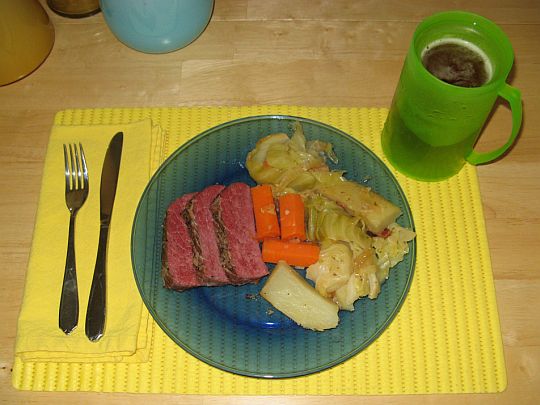
What else?
 Early spring bulbs bring color and beauty to the garden. This tulip, freshly spritzed, is no exception. Click on the image for larger.
From Wikipedia:
Tulips originate from mountainous areas with temperate climates and need a period of cool dormancy. They do best in climates with long cool springs and early summers, but they are often grown as spring blooming annual plantings in warmer areas of the world. The bulbs are typically planted in late summer and fall, normally from 10 to 20 cm (4 to 8 in.) deep, depending of the type planted, in well draining soils. In parts of the world that do not have long cool springs and early summers, the bulbs are often planted up to 12 inches deep, this provides some protection from the heat of summer and tends to force the plants to regenerate one large bulb each year instead of many smaller non blooming ones. This can extend the usefulness of the plants in warmer areas a few years but not stave off the degradation in bulb size and eventual death of the plants.
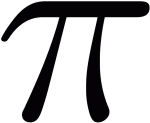 In keeping with the last nerdy post about mathematics, I would like to wish you a happy PI (3.14..) day! In my career in aerospace and also as a pilot and flight instructor, I use the quantity PI (approximately equal to 3.14159265) for all kinds of engineering and navigation applications.
In the excerpt below is the notion that you can approximate the value of PI by throwing needles or frozen hot dogs. Don’t laugh, it works – a group of us a long time ago in a lab at work performed the experiment using tongue depressors. The method uses the laws of probability to approximate PI when you divide the number of throws by the number of times a tossed object crosses one of the reference lines. The lines are set at intervals equal to the length of the objects being thrown.
From SpaceWeather.com
HAPPY PI DAY: March 14th (3.14) is PI day and all around the world mathematicians are celebrating this compelling and mysterious constant of Nature. PI appears in equations describing the orbits of planets, the colors of auroras, the structure of DNA. It’s everywhere.
Humans have been struggling to calculate PI for thousands of years. Divide the circumference of a circle by its diameter; the ratio is PI. Sounds simple, but the devil is in the digits. While the value of PI is finite (a smidgen more than 3), the decimal number is infinitely long:
3.1415926535897932384626433832795
02884197169399375105820974944592307
81640628620899862803482534211706…moreSupercomputers have succeeded in calculating PI to more than 200 billion digits and they’re still crunching. The weirdest way to compute PI: throw needles at a table or frozen hot dogs on the floor. Party time!
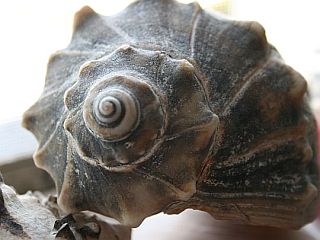 When Damsel snapped this picture of a seashell a couple of days ago, it reminded me of a class I took in school. One segment of this class studied the mathematics of pattern formations in nature. It was interesting to me then and has been interesting since.
The phenomenon of an expanding spiral, as in the photo, comes from a number progression known as the Fibonacci series. The series is formed by starting with 0 and 1 and then adding the latest two numbers to get the next number in the progression. The first Fibonacci numbers are 0, 1, 1, 2, 3, 5, 8, 13, and so on.
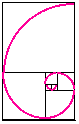 If you stack squares of dimensions in the Fibonacci sequence and connect the base intersections with a smooth curve, you get a spiral that resembles that of the shell. In the diagram at the left, two squares of dimension 1 are located in the center of the spiral, and squares of 2, 3, 5, 8 and 13 are added to the rectangle stack.
A property of the Fibonacci series is that as the series progresses, the ratio of adjacent numbers converges on a quantity known as the Golden Ratio or Golden Section. Golden Ratio comes from a name given by renaissance mathematicians. It was probably Leonardo da Vinci who first called it the sectio aurea (Latin for the golden section). The Golden Ratio appears regularly in arts, in architecture and in nature.
For everything you ever wanted to know about the Fibonacci series numbers and the Golden Section, visit Dr Ron Knott’s multimedia web site.
Recently, we started using a popular product called Strike Hold, a cleaner, lubricant and protectant (CLP) for metallic items, weapons in particular. Since we have been using it, cleaning the firearms after a session at the range is quicker and easier.
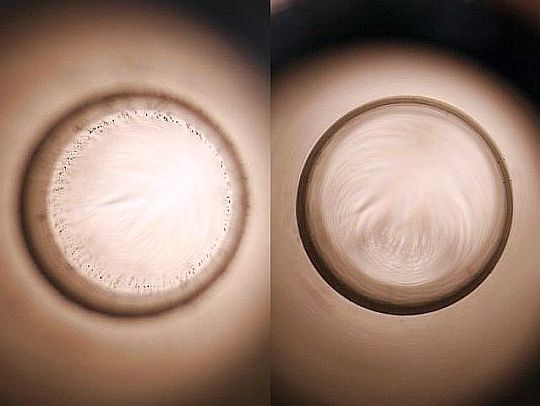
This is the before and after shot of my 20 gauge shotgun barrel before and after spritzing the product in the barrel and running a couple of patches through it. It replaces both the solvent and oil products previously used.
These three beautiful Sugarbird Daffodils are currently showing in the garden. Click on it to view wallpaper-sized.
