October 2006

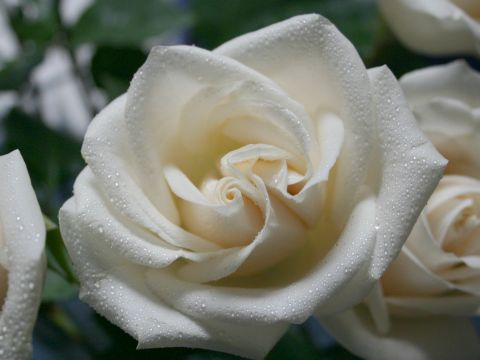
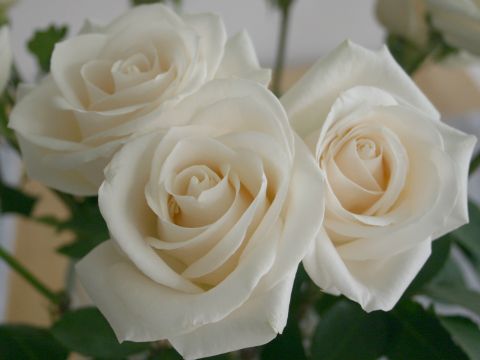
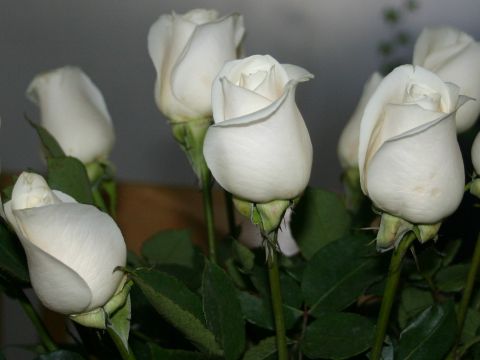
Vendela Roses

Think of creamy white ivory, high-centered blooms on extremely long sturdy stems. Add an outstanding vase life, and this extra productive beauty is here to please. We picked these up today instead of my favorite Asian lilies because they were sold out. But these will do!

UPDATE: They’re opening today!

UPDATE: They just keep on getting prettier!

The Colors of Autumn

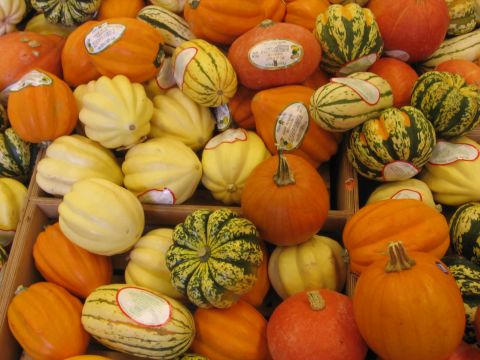
About this time of year, our grocer stocks a variety of fall squash, including these that make a colorful picture, emphasizing the colors of fall. We’re planning to purchase several varieties as we get closer to Halloween for table decorations to be displayed up until the time we change from Thanksgiving to Christmas.

Convergence

Over the next several days, Mars and Venus will converge on the Sun. This graphic (courtesy SOHO and NASA) is a movie of solar coronagraph pictures taken over the last few days. The outline of the Sun is the small white circle in the center. The dark circle is the solar shield in the imaging instrument. This allows images of the solar corona to be collected in spite of the bright light.

While not designed for this purpose, stars and planets are also frequently imaged. In the coming weeks planets Mars and Venus will pass behind and in front of the Sun, respectively. Neither planet will transit, or pass directly through the solar disk, but slightly above the ecliptic plane (defined by the orbit of the Earth).

Transits of Venus across the disk of the Sun are among the rarest of planetary alignments. Indeed, only seven such events have occurred since the invention of the telescope (1631, 1639, 1761, 1769, 1874, 1882 and June 8, 2004). Venus will do an encore on June 6, 2012. After that, it will pass above or below the solar disk for another 105 years or so.

Under the Harvest Moon

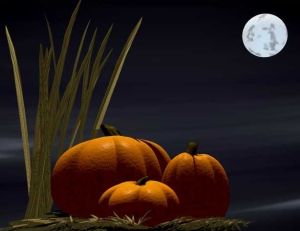
Depending upon where you are in the world, the Harvest Moon will take place on either this Thursday or Friday. The occurrence of the Harvest Moon in October happens about one in four years. The latest a Harvest Moon can occur is October 7th or 8th, depending on your relative position to the date line.

The Harvest Moon gets it’s name because it happens at the beginning of harvesting season in the Northern Hemisphere. Since modern agriculture is not as dependent on the light of the Harvest Moon, it has become a symbol for the beginning of the festive and colorful fall season. Halloween isn’t too far in the future and Thanksgiving Day will be here before you know it.

And speaking of moonlight, did you know that most people cannot perceive color nor can they read by the light of the moon? See NASA’s Strange Moonlight for some interesting information on the Harvest Moon and human eyesight in the moonlight.

No More Major Hurricanes in ’06

Researchers at Colorado State University are forecasting that no more major hurricanes will make landfall for the remainder of the 2006 hurricane season.

From Colorado State University:

FORT COLLINS – Developing El Nino conditions in the central and eastern Pacific have led the hurricane forecast team at Colorado State to continue to call for below-average activity for the remainder of the 2006 Atlantic basin hurricane season.

The forecasting team of Philip Klotzbach and William Gray today released a new report that calls for two more named storms, one more hurricane and no more intense or major (Saffir/Simpson category 3-4-5) hurricanes for the remainder of the hurricane season (October-November). With the observed activity through September 2006 of nine named storms, five hurricanes and two major hurricanes, a total of 11 named storms are predicted to form in the Atlantic basin during 2006 with six of these predicted to become hurricanes. Two major hurricanes with sustained winds of 111 mph or greater have already formed, and the forecast team does not expect any more major hurricane formations this year.
Inset: Dr. Gray and PhD candidate Klotzbach (photo credit CSU)

There were a couple of interesting FAQs on their website:

Q: Why are there fewer hurricanes at this time in 2006 than there were in 2005?
A: The 2005 hurricane season was very active, especially during the early part of the season (June-July). Although we believe the 2006 hurricane season will end up being close to the average season that occurred between 1950 and 2000, conditions for hurricane development are not as favorable this year as they were at this time last year. Some of the conditions that are less favorable this year are:

  1. Cooler tropical Atlantic sea surface temperatures
  2. Dryer tropical Atlantic mid-level atmosphere
  3. Higher tropical Atlantic sea level pressures
  4. Stronger tropical Atlantic vertical wind shear
  5. Warmer sea surface temperatures in the tropical eastern and central Pacific, possibly indicating the development of El Niño conditions this fall/winter.

Q: We’ve had a lot more activity in the Atlantic since 1995. Is global warming the cause of this increased activity?
A: The Atlantic basin tends to go through periods of about 25-35 years with heightened major (Category 3-4-5) hurricane activity and then similar periods of about 25-35 years with less activity. We believe that these multi-decadal variations are mostly due to changes in large-scale ocean circulations referred to as the Atlantic Ocean thermohaline circulation.

How inconvenient this must be for global warming alarmists!

An interesting related article “Hurricane Data Not Cooperating,” from World Climate Report discusses how the hurricane cycle works and that global warming is not involved.

Starfish Flower

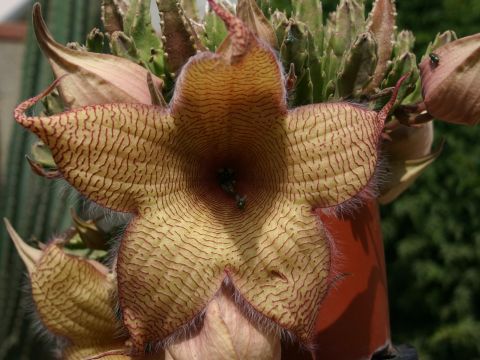
Damsel isn’t in to this strange flowering succulent, but I’m sort of entertained by it. In a way, it’s kinda disgusting, since it’s main pollinators are flies and it has a foul odor like roadkill. What’s interesting about this particular plant is that there are more pods blossoming into flowers than we’ve ever seen in the several years we’ve had it. I estimate there will be about 15 flowers this season — usually only one or two per season prior to now. It must be due to global warming (just kidding — sarcasm intended).

From Dave’s Garden:

Stapelia gigantea — Interesting succulent, olive green and erect. Lots of branches. 4-sided spineless stems average up to 9 inches and about 1 inch thick. Cactus-like appearance.

Grown mostly for the starfish-shaped flower. Flowers are pale yellow with reddish stripes, covered with white hairs. Flower can average 8 to 12 inches across. It is said to look flesh-like, also reported to have a rotting meat odor, which attracts its main visitor, the fly, for pollinating

This plant which is usually grown in pots is known by several common names which include the following: starfish flower, Zulu-giant, carrion flower and giant toad. It is native to southern Africa and Mozambique.

By the way, Dave’s Garden is one valuable resource when trying to learn about plants and flowers.

Hubble Back in Action

Slowly, this amazing instrument is becoming out-of-date, and things seem to be wearing out on it. Yet, because of backup systems, on-site repairs and remote engineering excellence, it keeps on ticking. Hopefully, it will remain functional until the James Webb Space Telescope becomes operational.

From NASA:

Hubble’s Advanced Camera for Surveys Resumes Exploring the Universe

After a brief hiatus, the Advanced Camera for Surveys aboard NASA’s Hubble Space Telescope is back in business, probing the far reaches of space in a quest to understand the true nature of the universe’s most dominant constituent: dark energy.

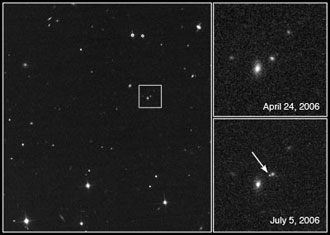
This is one of the first images of the universe taken after the ACS camera resumed science operation on July 4. The camera was offline for nearly two weeks as NASA engineers switched to a backup power supply after the camera’s primary power supply failed.


Image above: A cluster of galaxies with recent supernova. Image Credit: NASA.