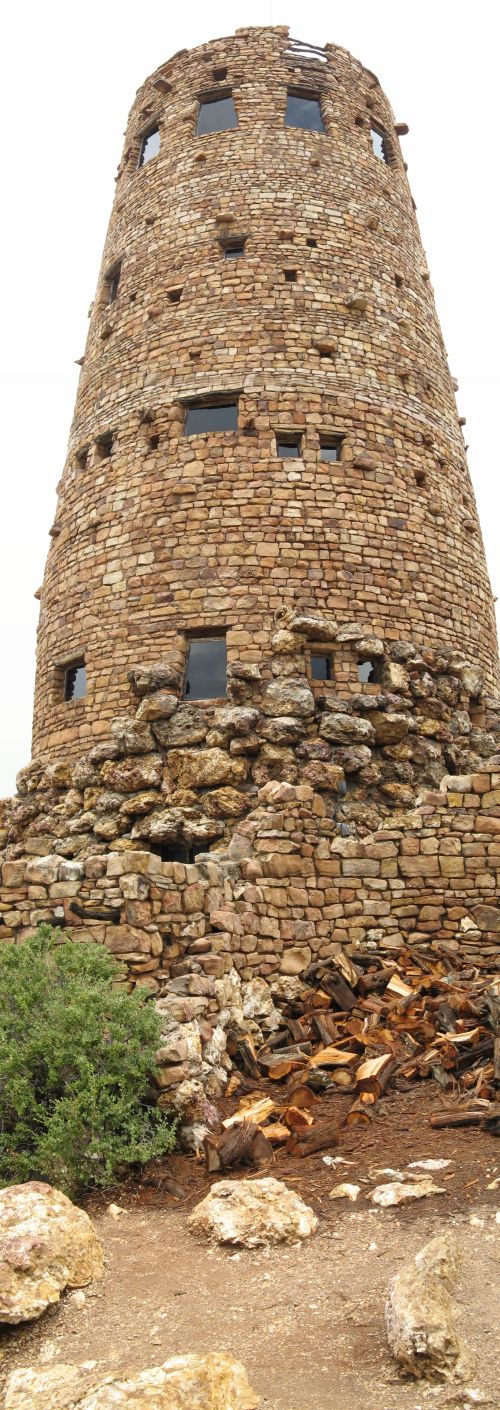
 In 1930, Fred Harvey commissioned Mary Colter to design and build a gift shop and rest area at the Grand Canyon’s Desert View scenic overlook. The Watchtower resulted from Colter’s efforts and was opened to the public in 1933.
The Desert View lookout and the Watchtower make for a climactic final stop if you are driving Desert View Drive from Grand Canyon Village, or a dramatic beginning if you enter the park through the East Entrance. From the top of the 70-foot stone-and-mortar Watchtower even the muted hues of the distant Painted Desert to the east and the 3,000-foot-high Vermilion Cliffs rising from a high plateau near the Utah border are visible. In the chasm below, angling to the north toward Marble Canyon, you can see an imposing stretch of the Colorado River. The Watchtower houses a glass-enclosed observatory with powerful telescopes.
I made the image at the left using a panoramic technique; first, I took three images of the tower in portrait mode, one above the other with slight overlap. Then, I ‘stitched’ them together using a software tool. The camera was my little Canon A710 IS and the photo stitch software was part of Canon’s Zoom Browser package which came with the camera. Click on the thumbnail to see a larger view of this unique tower.

 Our thoughts and prayers go out to the victims, families and friends after this terrible tragedy. Captain Ed at

 During our visit to San Diego, I took this panoramic view of the