Triplet Argentine Giant Flowers

Argentine Giant Flowers

Beautiful! My Argentine Giant (echinopsis candicans) cactus flowers have opened this evening. I took this photo at a little after six this evening. These flowers will still be open in the morning, but will fade soon after. This is our once-a-year blooming for this cactus we installed shortly after having the place landscaped in 2011. The three pods last evening were still unopened, but the flowers showed up late today. Click on the image to enlarge.

Agave Flower Stalk

Agave

There is an agave flower stalk about four hundred feet east of our driveway. I don’t know the timing on agave flowers, but I imagine this will be sprouting flower pods in the near future. We have been watching the flower stalk grow over the past several weeks and today I estimate it to be about fifteen feet tall. I will be sure and get flower pictures when the agave finally starts producing them. Click on the image to enlarge.

A Really Weird Queen of the Night Cactus


While I was up on the hill at the back of our property last week, I found several more of the Arizona Queen of the Night cacti. This one, in particular, is very weird; the woody part of the cactus comes out of the ground at the lower left of the image and winds up and across the branches of a palo verde, then descends toward the right side of the image before splitting in two and connecting to two fleshy stems rising upward. Roll your mouse over the image to highlight the strange routing of this specimen.

Realizing that the image above is lacking in detail, I uploaded a larger highlighted image here. I also uploaded images of the other three queens I found up on the hill here and here.

Since I know that this variety of cactus has a ball root, I imagine the big one must have a whopper. I read somewhere the roots could weigh in at hundreds of pounds.

Ocotillos in Bloom

Ocotillo Flowers

The ocotillos all over town are in bloom. I finally found an ocotillo near our favorite Mexican restaurant with canes low enough for me to get a close-up of the little red flowers. Click on the image to enlarge.

We had the landscaper install an ocotillo a couple of years ago, but sadly it seems to have died. The plan is to get them to replace it this summer. Hopefully I can take this kind of picture next year in our yard.

Transplant Candidate Hedgehog Cactus

Hedgehog Cactus

When I learned that it is legal to move protected native vegetation on our own property without permission from the Arizona Department of Agriculture, I selected this nice little hedgehog cactus up near the north property line as a candidate to move to the lower lot. It has only four lobes and will probably be light enough for me to dig up and carry to its new location. Succulents can be quite heavy since they consist of hydrated flesh and can contain several quarts of water in each lobe.

As soon as this guy stops flowering in June, I will carefully dig around it to be able to lift it out of the ground and into the wheelbarrow for transportation to the lower lot. I took this photo this morning. Click on the image to enlarge.

More Bishop’s Cap Flowers

Bishop’s Cap Flowers

I get these flowers for most of the year. It seems that the venerable little Bishop Cap cactus keeps on producing these after nearly seventeen years since we adopted it in a three-inch pot just before we got married.

The cactus had been transplanted three times and has lived with us in both California and Arizona and just keeps on giving us flowers. Click on the image to enlarge.

Pool Pee Panic

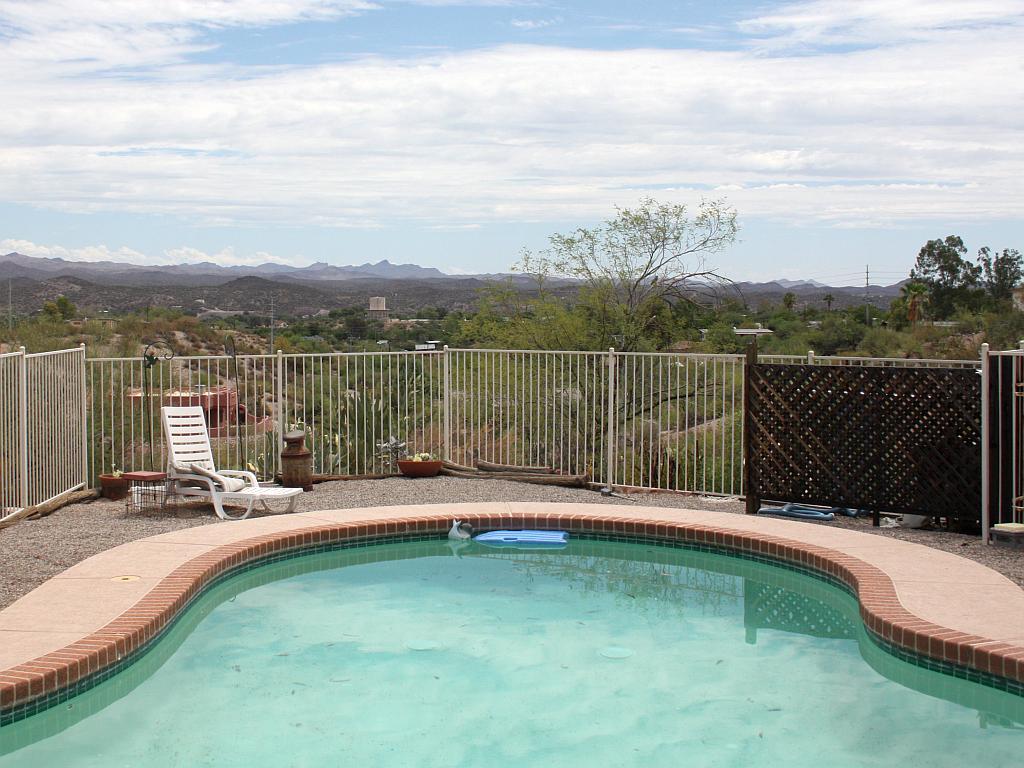
desert swimming poolGreg Pollowitz at Planet Gore wrote a rebuttal to a Time Magazine article entitled “No, It’s Not Safe to Pee in the Pool, Says Science.” The Time article claimed that components in the urine could combine with chlorine to produce chemicals potentially dangerous to humans.

While the “scientific” analysis that dangerous chemicals are produced was basically true, the quantities of chemicals were not discussed. Pollowitz wondered how many people urinating in a pool would be needed to kill a swimmer. He found additional research on the topic and discovered that to produce dangerous chemicals in an Olympic-sized pool, you would need about three million swimmers peeing in the pool. THREE MILLION! But wait, it gets better.

However, there’s a problem. The researchers in the paper showed that for a concentration of 0.33 millimoles of chlorine per liter (about 15 mg/L), the dilute concentration of uric acid (5×10⁻⁵ moles per liter) eliminated all of the free chlorine. Hence, if we want chlorinated water that can actually turn all of the uric acid we’re peeing in it into cyanogen chloride, we need a more concentrated chlorinated solution.

If an approximately one-hundredth-strength-of-pee concentration of uric acid uses up 15mg/L chlorinated water, we need super chlorinated water-—on the order of 1500mg/L, or roughly half a liter of chlorine per liter of water.

In the end, we need a pool that is two parts water to one part chlorine and would probably burn the eyeballs out of your sockets and make your skin peel away from your bones (this calls for a pool boy who can only be criminally sadistic). If you and three million other people could get at this pool and unload your pee into it before your bodies melted, before the crowd crushed you to death, and before you drowned from the massive tidal wave of pee… yes, you could feasibly die of cyanogen chloride poisoning originating from chlorinated water and pee.

To conclude, Pollowitz wrote:

And that’s why, boys and girls, we don’t trust everything we read in the MSM.
