Environment

Cooper’s Hawk

coopers-hawk.jpg

I went into the back yard this morning and saw a hawk perched on my garden utility cart. I quietly rushed back into the house to get my camera and quietly returned to get some photos. The young bird stayed long enough for me to get several images. The composite image above is made from the best of the perched and in flight images.

According to my copy of “Birds of the Los Angeles Region,” this is probably a juvenile Cooper’s Hawk. This species is a year-round resident in the area and is known to ambush smaller birds as they feed. Cooper’s Hawks are often seen hunting around bird feeders – our feeders are to the left of the perched image, just out of the frame.

This bird and his ancestors have been coming around our yard for several years. We enjoy seeing their beautiful plumage and love the way they glide and soar overhead showing off their flares feathers.

Have a Nice Nuke

have a nice nukeThe Democrats and the Obamadministration think it’s OK for Iran to enrich nuclear fuel for that country’s energy needs, yet the moratorium on new nuclear facilities for the US continues. Why is it OK for them and not OK for us?
At least some members of the U.S. House and Senate are trying to get some traction for nuclear energy by leveraging the Anthropogenic Global Warming (AGW) myth.

Via Planet Gore

We Need 100 Nukes by 2030 [Carl Shockley]

After fumbling over the Waxman-Markey initiative for several months, Republicans have finally hit their stride. Both House and Senate members are quickly falling behind the rallying cry, “100 New Reactors by 2030.”

“I think global warming is a real problem but I don’t think the solutions the Democrats are coming up with are going to accomplish anything,” said Sen. Lamar Alexander (R., Tenn.), head of the Senate GOP caucus. “The only thing that’s going to allow us to cut carbon emissions is clean nuclear energy. We built 100 reactors between 1970 and 1990. We can do the same thing now. If global warming is the inconvenient problem, then nuclear power is the inconvenient answer.”

Alexander and three other Tennessee legislators were on hand Wednesday morning as Babcock & Wilcox introduced its new “mPower” 125-megawatt modular reactor that it will submit to the Nuclear Regulatory Commission in 2011. The $750 million reactor will be built in a factor and shipped to the site by rail, where it would be completely buried underground and refuel only once every five years. “Everything in this reactor would be made in America,” said Republican Bob Corker, Tennessee’s other senator.

Congressman Zach Wamp (R., Tenn.) warned that the United States is falling behind other countries in nuclear technology. “What we’re talking about here isn’t just a revival of the nuclear industry,” he said. “We’re talking about an American industrial renaissance.

Power generation using conventional coal technology has been mathematically proven to have little effect on AGW. We should continue to use coal powerplants. In addition, we should resume nuclear generation, as it is clearly a better and more efficient method of producing the energy our nation needs, regardless of whether it actually does anything to improve the environment.

National Parks Web Cameras

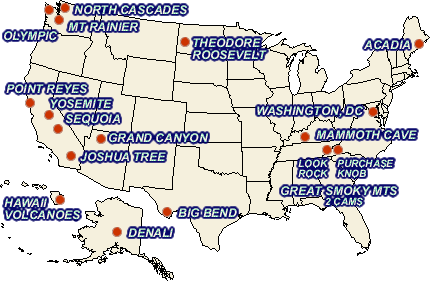
Every once in a while, when I’m at my desk working, I get a twinge of wanderlust. When the great outdoors calls me, I go to the National Park Service Web Cameras page. From there, I can navigate to some of our favorite places in near real time.

I made this mosaic from several of the images I looked at during my lunch break.

NPS mosaic

Available webcams on the NPS Page:

NPS Cams

Even though the mission of the webpage is to raise awareness of air quality, I like the instant gratification of seeing what the conditions are like in several different parks across the country.

Disclaimer: Some sites are in maintenance mode and the Hawaiian volcano site does not have a camera. Bookmark the site and when you get wanderlust, you can get a peek into the great outdoors.

From the page:

The National Park Service operates digital cameras at many parks to help educate the public on air quality issues. These cameras often show the effects of air pollution such as visibility impairment. Because these cameras are typically located near air quality monitoring sites, the camera web pages display other information along with the photo such as current levels of ozone, particulate matter, or sulfur dioxide air pollutants, visual range, and weather conditions.

The Road From Phoenix

We drove out of the campground today and headed toward Wickenburg, AZ. We had a great time in Phoenix at the NRA convention and afterward just relaxing and camping.

The picture below shows typical scenery along Arizona SR74 en route to US60 on the way to Wickenburg, where we currently are camping. Among the several varieties of vegetation seen here are Saguaro cactus, Cholla, Ocotillo, and mesquite. We think these are very beautiful and many are flowering. Click on the image to enlarge.

road-from.jpg

Your CO2 Footprint and the “Magic Number”

The following has been excerpted from World Climate Report. Using the ‘magic number’ they developed with exhaustive back of the envelope calculations, they have arrived at a way that you, as a ‘polluter,’ can actually see to what extent you are causing (or ‘preventing’) temperature change.

Of course, this assumes that the Sun has little or nothing to do with climate change. Click on the link below if you want to see WCR’s complete analysis.

What You Can(‘t) Do About Global Warming

magic.pngThis is a handy-dandy and powerful piece of information to have, because now, whenever you are presented with an emissions savings that some action to save the planet from global warming is supposed to produce, you can actually see how much of a difference it will really make. Just take the emissions savings (in units of million metric tonnes (mmt) of CO2) and divide it by 1,767,250.

We are always hearing about ways that you can “save the planet” from the perils of global warming—from riding your bicycle to work, to supporting the latest national greenhouse gas restriction limitations, and everything in between.

In virtually each and every case, advocates of these measures provide you with the amount of greenhouse gas emissions (primarily carbon dioxide) that will be saved by the particular action.

And if you want to figure this out for yourself, the web is full of CO2 calculators (just google “CO2 calculator”) which allow you to calculate your carbon footprint and how much it can be reduced by taking various conservations steps—all with an eye towards reducing global warming.

However, in absolutely zero of these cases are you told, or can you calculate, how much impact you are going to have on the actual climate itself. After all, CO2 emissions are not climate—they are gases. Climate is temperature and precipitation and storms and winds, etc. If the goal of the actions is to prevent global warming, then you shouldn’t really care a hoot about the amount of CO2 emissions that you are reducing, but instead, you want to know how much of the planet you are saving. How much anthropogenic climate change is being prevented by unplugging your cell phone charger, from biking to the park, or from slashing national carbon dioxide emissions?

Why do none of the CO2 calculators give you that most valuable piece of information? Why don’t the politicians, the EPA, and/or greenhouse gas reduction advocates tell you the bottom line?

How much global warming are we avoiding?

Embarrassingly for them, this information is readily available.

Let’s say that you decide to stop driving your SUV for a year. According to NativeEnergy.com, you would circumvent causing 24 metric tons of emissions.

Wow! That’s a lot!

Now, let’s do the magic number thing. First, convert 24 metric tons in terms of million metric tons = 0.000024 mmt. Divide that by 1,767,250 = 0.0000000000136°C/year.

If you lack the fortitude to actually make these sacrifices to prevent one hundred billionth of a degree of warming, for $364 each year, NativeEnergy.com will offset your guilt.

Talk about Ponzi schemes . . .

Given the draconian Waxman–Markey bill before the House of Representatives, this magic number will show just how little carbon caps will help. Just consider how devastating to the economy these Congressional Ponzi schemes will be if the bill passes.

See “The Waxman-Markey ‘Climate’ Bill Does Nothing for the Climate