Culture

National Park Service 90th Birthday

Happy Birthday, National Park Service!
On August 25, 2006, the National Park Service celebrates its 90th birthday. Created in 1916 under the Organic Act, Congress and President Woodrow Wilson charged the Park Service with overseeing 35 public land units to preserve America’s vast diversity for future generations.

Much has changed in 90 years! Now, not only does the National Park Service manage all of America’s 390 park units, its responsibilities have grown into complex fields, such as scientific research, archeology, historic preservation, interpretation and education outreach. Over 84.4 million acres of parkland provides habitats for 369 threatened or endangered species, houses 100 million items in museum collections, contains 1.5 million archaeological sites and protects 27,000 historic structures. Our beloved National Park sites are visited 277 million times a year, employ 20,000 employees, and receive valued assistance from 144,000 volunteers per year.

Can’t think of the just right birthday gift? Donate to the National Park Foundation to ensure America’s greatest collection of natural, cultural and historic sites are taken care of for the next 90 years!

Story courtesy NPS Newsletter
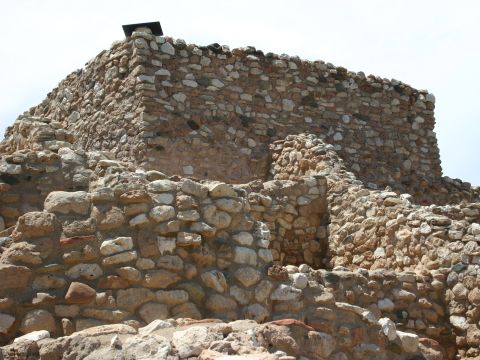
Tuzigoot

Tuzigoot is the Apache word meaning “crooked river.” This was the name arbitrarily given the Sinagua Native American ruins above a big bend in the Verde River near Cottonwood, AZ. This was an interesting stop that we made during our brief but fun vacation. Cap’n Bob also took a 3D picture of this ruin (you will need a pair of red/blue 3D glasses).

From the National Parks page on Tuzigoot National Monument

Crowning a desert hilltop is an ancient pueblo. From a roof top a child scans the desert landscape for the arrival of traders, who are due any day now. What riches will they bring? What stories will they tell? Will all of them return? From the top of the Tuzigoot Pueblo it is easy to imagine such an important moment. Tuzigoot is an ancient village or pueblo built by a culture known as the Sinagua. The pueblo consisted of 110 rooms including second and third story structures. The first buildings were built around A.D. 1000. The Sinagua were agriculturalists with trade connections that spanned hundreds of miles. The people left the area around 1400. The site is currently comprised of 42 acres.

Historic Route 66

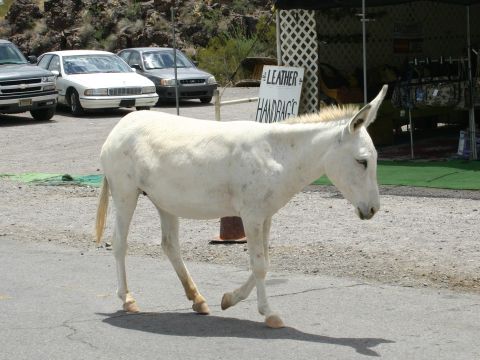
Today, we drove part of Historic Route 66 from Kingman, Arizona through Oatman, Arizona. Wild but tame burros wander the streets of Oatman accepting handouts from tourists. I snapped a picture of this nice white burro walking up the street.

Oatman began about 90 years ago as a mining tent camp and quickly became a flourishing gold-mining center. In 1915, two miners struck a $10 million gold find, and within a year, the town’s population grew to more than 3,500.

Oatman was named in honor of Olive Oatman, who was kidnapped as a young girl by Mojave Indians and later rescued in 1857 near the current site of the town. Oatman was served by a narrow gauge rail line between 1903 and 1905 that ran 17 miles to the Colorado river near Needles, California.

But both the population and mining booms were short-lived. In 1921, a fire burned down many of the smaller shacks in town, and three years later, the main mining company, United Eastern Mines, shut down operations for good. Oatman survived by catering to travelers on old U.S. Route 66. But in the 1960s, when the route became what is now Interstate 40, Oatman almost died.

The Grand Canyon Watchtower

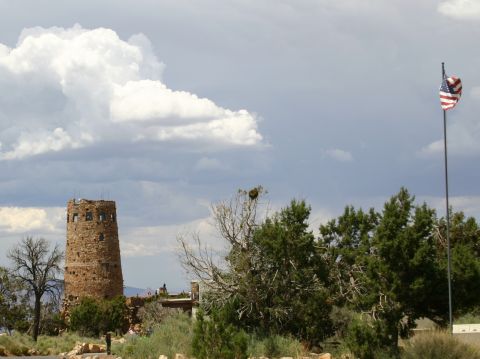
Today, we drove from Flagstaff to the Grand Canyon. We had wonderful weather and a great day at the rim. This is a picture of the Watchtower at Desert View scenic area. Notice the nest near the picture center — we saw many hawks in the canyon and this may be one of their nests. The American Flag on the right is in front of the ranger station there.

The Indian Watchtower is at the eastern end of the south rim of the Grand Canyon. From a distance the building’s silhouette looks like the Anasazi watchtower it was meant to mimic. In actual size the tower is considerably larger than any known Anasazi tower. In plan the structure is composed of one enormous circle at the north, a small circle at the south, an gently arced forms connecting the two. The largest circle and the arced portions are the sections of that building that are just one story in height. The smaller circular plan is for the tower itself, more than five stories high. The building sits out on a promontory overlooking the Grand Canyon.

Montezuma’s Castle

Today, we started out in Payson, Arizona and drove to more Native American ruins — Montezuma’s Castle and Tuzigoot National Monuments.

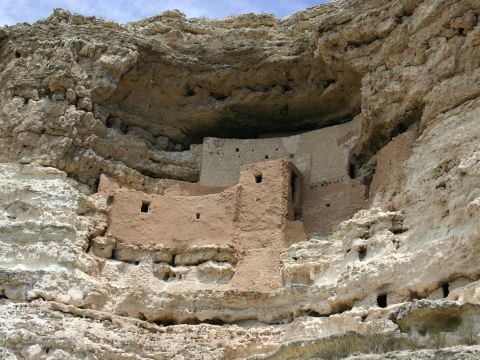
This is a shot of Montezuma’s Castle near Camp Verde, Arizona. Two things though — it’s not a castle and Montezuma was never there.

Big House in the Sun

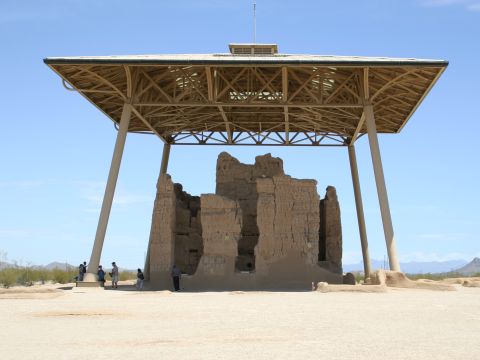
Casa Grande” is the Hohokam Native American ruins located near Coolidge, Arizona. The Hohokams had an interesting civilization. They farmed and irrigated crops using complex engineering skills. The four walls of this house are aligned with the four points of the compass. There is a feature where holes in the walls projected light onto a particular place on the wall to indicate equinoxes and solstices. Sort of like Stonehenge, I suppose. After our visit we headed to the Arizona High country. More on that tomorrow.

Interpretive Center

Yesterday, we went to the newly-renovated Point Vicente Interpretive Center. Located at the southwestern tip of the Palos Verdes peninsula, the center’s main focus is on marine wildlife including whales, dolphins, porpoises, seals, sea lions and waterfowl. They also have an exhibit dedicated to the US Coast Guard. We enjoyed our visit, especially the 20 minute video about whales and other sea life.

I snapped this picture of a raven swooping over the cliffs by the whale watching area.

RPV marine facility is set to reopen

The Point Vicente Interpretive Center, featuring new decor and exhibits on whales, sharks and dolphins, admits visitors Saturday for the first time in seven years.

The Point Vicente Interpretive Center in Rancho Palos Verdes has always been known as a good place to see whales. But the newly expanded center, which opens Saturday after seven years of work, takes things to a whole new level.

There are stone whales embedded in the ground, fiberglass whales hanging from the ceiling and painted whales on the walls. “It’s breathtaking,” said manager Holly Starr, who joined the center shortly before it closed in 1999.

[more]