Arizona

Gas Under Two Bucks

Under $2Gas prices have been coming down all over the country since the summer season ended. The lowest prices here in our town are still over two per gallon, but when we were going down to the Northwest Valley today, we saw gas advertised for under $2.

Having recently made a commitment to a new gas consumption entity, we have been tracking gas prices. When we take delivery of the new beast after Thanksgiving weekend, we will need to top off the 80 gallon tank. Searching on Gas Buddy reveals a lot of prices near the delivery location to be just a shade over two bucks; hopefully, those will go down by the time we get there.

One of the business magazines (I don’t link to any Bloomberg sites because they are rabidly anti-second-amendment) speculates that gas prices could fall to $1.70 or below by Christmas. That will be good for us since we will be going to Palm Desert California one more time before then and gas will probably keep coming down in price.

Dark Backed Goldfinch

Goldfinch

I was in the courtyard today with my camera intending to take some photos of Bob planting a couple of new xeriscape acquisitions when I noticed this little goldfinch taking seeds from the front feeder. He was not startled by my appearance in the courtyard and just stayed perched on the feeder taking the Nyjer seeds. I approached him and got several shots like the one above before he finally took off.

I looked up goldfinch on Wikipedia and found that there are several varieties of them. The ones that come around here are called the Dark Backed “Lesser” Goldfinch. They are a very small songbird according to the Wikipedia Article:

The lesser goldfinch or dark-backed goldfinch (Spinus psaltria) is a very small songbird of the Americas. Together with its relatives the American goldfinch and Lawrence’s goldfinch, it forms the American goldfinches clade in the genus Spinus sensu stricto.

The American goldfinches can be distinguished by the males having a black (rarely green) forehead, whereas the latter is (like the rest of the face) red or yellow in the European goldfinch and its relatives. North American males are markedly polymorphic and 5 subspecies are often named; at least 2 of them seem to represent a less-progressed stage in evolution however.

Fall Weather

Fall Weather

The second spring seems to have come to an end since the lows are now in the mid-forties and the highs rarely get above 70. Fall is upon us, I’m afraid.

The porch thermometer was at 48° after nine this morning when we took the dogs for their first morning walk. With the little breeze blowing, it felt more like 38°.

The forecast is for warmer on the weekend when we will be attending our annual Bluegrass Days festival up at the rodeo grounds. More on that later. Meanwhile, enjoy the image of a nice cool afternoon in our corner of the desert. Click on the image to enlarge.

Sacred Datura

Sacred Datura

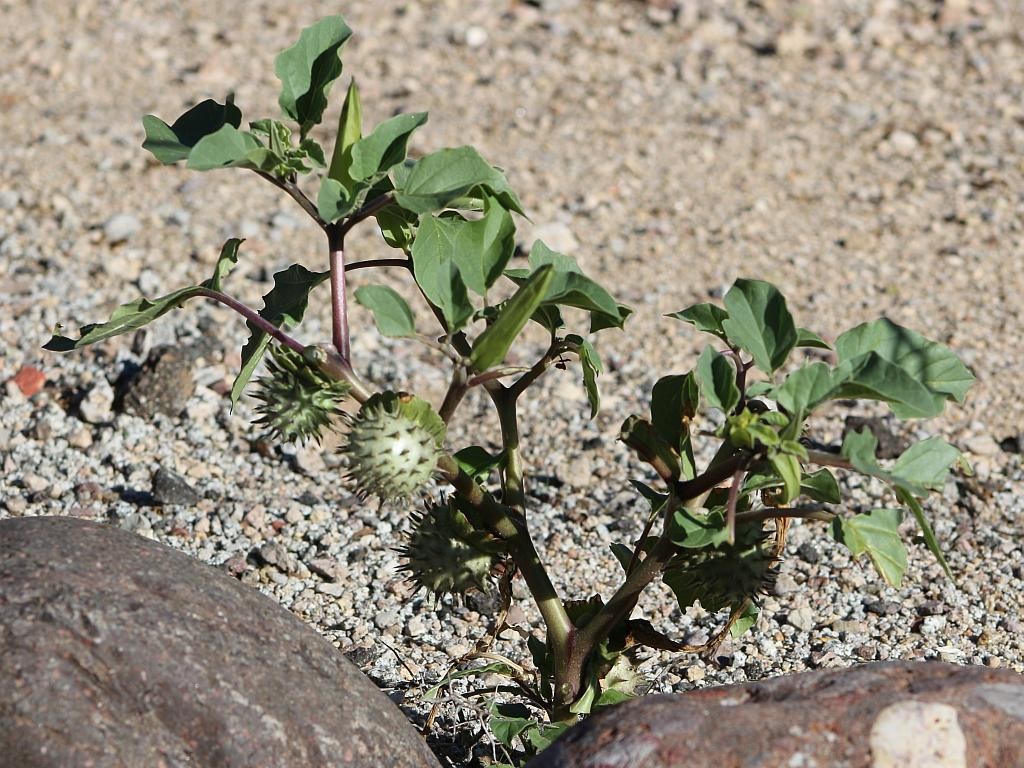
When we walk the dogs for their daily trip up the road, we pass a neighbor’s property which is still unimproved/unmaintained natural desert, complete with creosote, mesquite, cat’s paw and a host of native cacti. There is this one little shrub that we have been passing and not paying much mind to it. Recently, seed pods resembling blowfish have appeared. Out of curiosity, I went to our desert guide to see if I could find a match. I found Sacred Datura to be a match for what we were seeing.

I looked up sacred datura on Wikipedia and found that the binomial name was Datura Wrightii which is a hallucinogenic herb used by some native American tribes.

Datura wrightii or sacred datura is the name of a poisonous perennial plant and ornamental flower of southwestern North America. It is sometimes used as a hallucinogen. D. wrightii is classified as a deliriant and an anticholinergic.

It is a vigorous herbaceous perennial that grows 30 cm to 1.5 m tall and wide. The leaves are broad and rounded at the base, tapering to a point, often with wavy margins. The flowers are the most striking feature, being sweetly fragrant white trumpets up to 20 cm (7.9 in) long, often tinted purple, especially at the margin. Five narrow points are spaced symmetrically around the rim. It can bloom from April to October. In clear weather, flowers open at nearly full dark and wither a few hours after sunrise the following morning; in cloudy weather, they may open earlier and last longer.

The seeds are borne in a spiny, globular capsule 3 to 4 cm in diameter, which opens when fully ripe.

D. wrightii is found in northern Mexico and the adjoining U. S. states, as far north as southern Utah, in open land with well-drained soils. It is also commonly planted as an ornamental, especially in xeriscapes.

The name commemorates the botanist Charles Wright.

Given that it is used in xeriscapes, we might try and obtain some of the seeds to cultivate new plants we can use for the rock and cactus garden.

A Desert Rainbow

A Desert Rainbow

The end of the showers associated with the cold front that passed through here last evening produced this nice desert rainbow seen above our little cottage and the big saguaro as the sun began to set. Today, the cold air mass left in the wake of the front held our high temperature to about 61 degrees. A far cry from what it was a scant 30 days ago with daytime temperatures over 90 degrees. Oh, well, we just put on the long pants and sweaters and we’re OK. Click on the image to enlarge.

Ancient Native American Petroglyphs

Petroglyphs

These petroglyphs are clearly visible from US Highway 60 as we travel through a little mountain pass between Hope, AZ and Harcuvar, AZ. I captured this image as we drove through the pass just before the curve where you exit the pass and go into Harcuvar, just to the east of the etched rocks.

The symbology on these rocks is similar to other native petroglyphs readily available to be seen throughout the southwest US. Although we did not stop this time, I can tell you from previous visits to this place that the inscriptions are well-preserved and, fortunately, not tagged or disrupted by modern day idiots would-be petroglyphographers. Click on the image to enlarge.

Outback Mail Boxes

Outback Mail Boxes

We pass a lot of mail box clusters when traveling along US 60 in the Arizona “outback,” between Wickenburg and Interstate 10 near Brenda, AZ. This particular cluster is near Hope, AZ. There is nothing particularly interesting about mail boxes except this cluster has one mail box that is eight feet off of the ground. What’s up with that?

I took this photo today on our way to Palm Desert, CA. We are amused by the maverick mail box and as we have passed this spot dozens of times in our travels between home and California. We wonder if there is a big rig RV or truck that uses that box or if it is simply a joke. It is just plain weird and funny at the same time.