Aerospace

20th Anniversary of the B2 Spirit Rollout

Out of the Black and into the Blue

B2 Spirit in flight over Edwards Air Force Base

On July 17, 1989 at Edwards Air Force Base, Northrop and the United States Air Force rolled out this magnificent aircraft. I watched the closed circuit TV coverage from the media center at Northrop Electro-Mechanical Division in Anaheim, California.

Damsel and I later had the privilege to visit the B2 production facility in Palmdale for a group tour and a fly-by. It was spectacular.

Photo taken by The Flying Kiwi at the 2005 Air Show at Edwards Air Force Base. Be sure and visit the link for more photos from the air show. Click image to enlarge.

A Non-Military War Hero

jerry-huben.jpgAfter 68 years on the job, 88 year old Jerry Huben is calling it quits. During his career in aircraft engineering, Jerry contributed to the effort in every war since WW2. In doing so, he is just as heroic as many that were on the front lines.

Just like “Rosie the Riveter,” folks like Jerry got us through some pretty tough times and kept us safe and free. God bless him in retirement.

Image: Jerry Huben.

From the Daily Breeze:

Huben’s career at Northrop gave him an intimate view of the aerospace industry from the days when it was dominated by propeller-driven aircraft to the current age of stealthy flying wings.

After receiving a one-year certificate in engineering, Huben took a riveting job with what was then called Northrop Aircraft Co. in Hawthorne. That was Nov. 10, 1941, two years after Jack Northrop founded the business.

Huben was 20 years old.

He had wanted to work as an engineer, but Northrop didn’t have many engineering openings, he recalled.

About three weeks later, the surprise attack on Pearl Harbor changed America and the direction of Huben’s career.

He transferred to Northrop’s engineering department as the nation’s aerospace industry kicked into high gear.

“After that, things really took off,” Huben said. “The company was running round the clock, 24 hours a day, seven days a week. In engineering, we worked 10 hours a day, six days a week.”

Huben said a hearing impairment kept him out of the war.

America’s involvement in World War II also motivated Huben in his job.

“I felt compelled very much to give it (my) all and follow my imagination and dedication to helping the war (effort),” he said.

Among the planes Huben worked on were the P-61 Black Widow, T-38 Talon, F/A-18 Hornet and B-2 Spirit, which is a flying wing virtually invisible to radar.

Kepler Spacecraft Launch

kepler.jpgLast evening, we tuned into NASA TV to watch the launch of the Kepler Spacecraft. The countdown procedures went as originally anticipated and the launch was successful.

Kepler’s mission is to statically observe a patch of our galaxy consisting of roughly one hundred thousand stars. The instrumentation consists of a photometer which will monitor the emissions of the stars to try and detect extra-solar planets. The spacecraft can detect the slight dimming of a star as a planet passes in front of it.

Of course, the orbits of such planets would have to be at an angle where the transit would align with Kepler’s line of sight. I’m hoping that the NASA scientists factor the probability of alignment into their equation to determine the planetary count.

The image above (click to enlarge) is an artist’s rendering of what our galaxy might look as viewed from outside our Galaxy. Our sun is about 25,000 light years from the center of our galaxy. The cone illustrates the neighborhood of our galaxy that the Kepler Mission will search to find habitable planets. Credit: Jon Lomberg.

Space Gridlock

After the collision of two polar-orbit satellites this week, it is worth the time to take a look at just how crowded the ‘technosphere’ is getting. This graphic presents an interesting perspective of the situation. But, in reality, if the the relative size of satellites in this picture were in the same scale as the planet, none of them would occupy even a single pixel – that is to say, they would be invisible. Click for large image.

Beehive of Satellites

From today’s NASA Image of the Day:

A Beehive of Satellites

The launch of the first artificial satellite by the then Soviet Union in 1957 marked the beginning of the utilization of space for science and commercial activity. During the Cold War, space was a prime area of competition between the Soviet Union and the U.S.

In 1964 the first TV satellite was launched into a geostationary orbit to transmit the Olympic games from Tokyo. Later, Russian launch activities declined while other nations set up their own space programs. Thus, the number of objects in Earth orbit has increased steadily — by 200 per year on average.

The debris objects shown in the images are an artist’s impression based on actual density data. However, the debris objects are shown at an exaggerated size to make them visible at the scale shown.

Image Credit: European Space Agency

Methane on Mars

Scientists don’t yet know enough to say with certainty what the source of the Martian methane is, but this artist’s concept video depicts several possibilities. In this video, conjecture is offered for several possibilities. First, meteoric debris reacting with atmospheric particles possibly generating methane, next comet and meteor impacts creating chemical reactions resulting in methane production. Third, subsurface water, carbon dioxide and the planet’s internal heat combine to release methane, and, finally, living microbes actively producing methane as a waste product.

Whatever the process is, there is clear evidence that Mars is ‘farting’ methane.

The Most Beautiful Aircraft Ever Flown

As I made my rounds through reading the blogs today, I ran across a post that made a connection to the SR-71, which got me to look for this favorite picture of that magnificent aircraft.

As for the post (hat tip to The Liberty Sphere), it was not really about the SR-71, but about a speech made by a former pilot of one of these. These patriotic words of Brian Shul are partially listed at the Bloviating Zeppelin who has a very nice article and picture of Shul: Good Morning Monday: A Speech We NEED To Remember.

sr71.jpg

If you want to see this bird full-sized, click on the image above.

STS-126

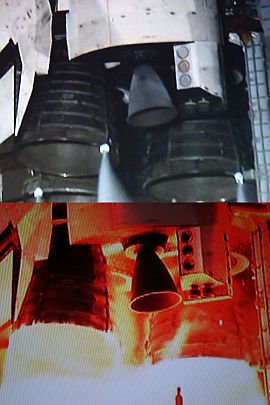
liftoff.jpgSTS-126 is on the way to the ISS. Damsel snapped these from the TV before and after engine ignition.

This is the NASA account the launch thus far:

Go for Launch!
Fri, 14 Nov 2008 04:46:20 PM PST

NASA’s mission managers have announced a “go” for launch! The countdown for the STS-126 mission has entered its final moments. Automatic systems at the launch pad will remove the remaining equipment out of the way of space shuttle Endeavour so it can make its climb into space.

Endeavour Soars Into the Night Sky!
Fri, 14 Nov 2008 05:07:21 PM PST

Space shuttle Endeavour roared off Launch Pad 39A at NASA’s Kennedy Space Center on a spectacular tower of smoke and flames. The STS-126 mission is an extremely ambitious undertaking, highlighting four spacewalks and delivering the heaviest payload in shuttle history.

External Tank and Boosters Away!
Fri, 14 Nov 2008 05:09:23 PM PST

The giant orange tank that provided fuel for Endeavour’s climb into space is now empty and is jettisoning from the shuttle. As the tank falls away and descends toward Earth, the tank’s on-board cameras record the process. About two minutes into flight, the solid rocket boosters propelling Endeavour higher into space have successfully separated and gracefully fallen away. Each booster has a parachute packed in its frustum that will automatically deploy after entering Earth’s atmosphere to slow the descent into the ocean. Endeavour has safely attained orbit and NASA mission managers have given the command to proceed with main engine cutoff, also known as MECO. Less than 10 minutes after launch, Endeavour was orbiting around Earth. Within 24 hours, Endeavour will meet up and dock with the International Space Station.