January 2009

Stop Whining About Hurricane Katrina

hurricane.jpgThe science is in on the effects of temperature and hurricane intensity and it doesn’t implicate Global Warming, but rather just the opposite. It’s time for the perpetual victims of Katrina (not actually that strong of a storm Rita was much stronger) to stop whining about the non-existent connection between warm climate and hurricane intensity.

I read the article Tropical Cyclones (Atlantic Ocean – Global Warming Effects: Intensity) — Summary on the CO2 Science website and these paragraphs jumped out at me:

As a result of these efforts, the two researchers determined that “alternating periods of quiescent conditions and frequent hurricane landfall are recorded in the sedimentary record and likely indicate that climate conditions may have modulated hurricane activity on millennial timescales.” Of special interest in this regard, as they describe it, is the fact that “several major hurricanes occur in the western Long Island record during the latter part of the Little Ice Age (~1550-1850 AD) when sea surface temperatures were generally colder than present,” but that “no major hurricanes have impacted this area since 1893,” when the earth experienced the warming that took it from the Little Ice Age to the Current Warm Period.

Noting that Emanuel (2005) and Webster et al. (2005) had produced analyses that suggest that “cooler climate conditions in the past may have resulted in fewer strong hurricanes,” but that their own findings suggest just the opposite, Scileppe and Donnelly concluded that “other climate phenomena, such as atmospheric circulation, may have been favorable for intense hurricane development despite lower sea surface temperatures” prior to the development of the Current Warm Period. Perhaps, therefore, we have much-maligned global warming to thank for the complete absence of major hurricanes in the vicinity of New York City over the past 115 years.

Emphasis mine.

So the Little Ice Age (Maunder Minimum) brought havoc to the North Atlantic Region and since then the storm intensities have subsided. So it seems that the sunspots influence global temperatures in a manner that’s inversely proportional to the intensity of hurricanes in the North Atlantic.

This is one more scientific clue that the clueless will ignore.
Smith and Western

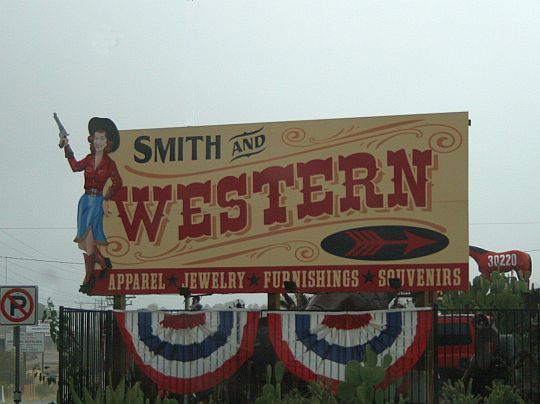
We liked the town of Wickenburg, Arizona, when we were there a couple weeks ago. It seemed to have a nice out-west hometown feeling to it. We stayed at an RV park where the people that we dealt with were friendly and hospitable.

On our way out of town I snapped this shot of a billboard that captures a bit of the essence of the town. I liked the gun-friendly play on words. We were definitely not in California, anymore, Toto.

smith-western.jpg

Range Report

We had an interesting and fun time today at the range. At first, it was pretty busy, with most of the lanes occupied with shooters. Later, business seemed to taper off a bit with just us and one other booth occupied. I guess that folks were home watching wild card football playoffs or something.

I snapped three images of the sparsely occupied range and stitched them together to make this panoramic image. Because she moved between the second and third snapshots, Damsel appears to be two people. Click for full-size.

range-pan.jpg

Shooting was great today. We each shot about 100 rounds of .45s using the Glock 30 and the Warthog – which had NO misfeeds today. We also shot a couple of boxes of 9mm through the Glock 26 and S&W 908s. We even shot about 35 rounds of .38 special with Damsel’s S&W 686. To top it off, we shot 25 rounds each of 20 and 12 gauge with the Remington 870s.

We both agree it was a pretty good day of shooting.

Update: Thanks to Robb Allen for his link to this article.

Snowbound Clown-Mobile

trailer-village.jpgWe rented a Cruise America® motorhome for our recent winter vacation. This was the first time we have traveled this way, as booking hotel accommodations is our usual travel mode. Since we wanted to bring our dog with us this time, we decided to try out the RV.

Shortly after we got on the road, Damsel started referring to our cruiser and others we saw on the road as the “clown-mobile.” Damsel figured the billboards painted on all sides of the vehicles made them look like part of a circus parade.

Image: Our clown-mobile in 1½ feet of snow at Trailer Village Campground – click for big

Most of the trip went well, with a couple of instances where all was not as well as it could have been. At the Grand Canyon Trailer Village Campground, we had an incident where we got stuck in the snow making the turn into the row where our campsite was located. After a bunch of digging and throwing a bunch of cinders under the duals, we were still stuck. We finally got the local AAA to pull us out, but we still needed to assist with more cinders and by engaging the motorhome drive. Once free, we got into our campsite and left the next morning without further incident.

The only other ‘incident’ was my choice of routes leaving Death Valley after our visit there – California State Route 190 from Stovepipe Wells to Olancha. It was a winding mountain road, which wouldn’t have been that much of a problem except that the setting sun was directly ahead in the general direction of travel which compromised visibility looking into the curves.

She didn’t mind getting stuck in the snow that much, but Damsel promised to file for divorce if I ever pick a road like SR190 again.

Bright Angel Canyon – Summer and Winter

Bright Angel Creek, part of the greater Grand Canyon complex, empties into the Colorado River just below Grand Canyon Village. The creek formed Bright Angel Canyon in much the same way the Colorado eroded its way through Grand Canyon. When you look down from the Village, you look straight into Bright Angel Canyon.

summer-bright-angel.jpgDuring the summer months, the sun is high in the sky at mid-day and the vivid colors of the sculptures in the canyon are truly inspirational. The sky can be gray with frequent thunderstorms in the area, or it can be blue, with flat-bottomed cumulus clouds floating above the canyon rim. The summers are warm at the South Rim with temperatures ranging between the high 70s and low 90s. When I took this shot of the canyon last summer, the temperature was in the low 80s.

winter-bright-angel.jpgWinter brings a variety of conditions, ranging from fog and low clouds that obscure the canyon, to high winds which chill to the bone. Occasionally, a cold front will bring snowfall that can last for several days and will ice things up pretty good. The latter condition prevailed during our recent visit to the canyon. We stayed in the trailer village overnight and went to the rim to capture this winter view with low sun angle and long shadows. The snow was pretty deep in most places and the roads were pretty icy.

You can click on either image to enlarge.

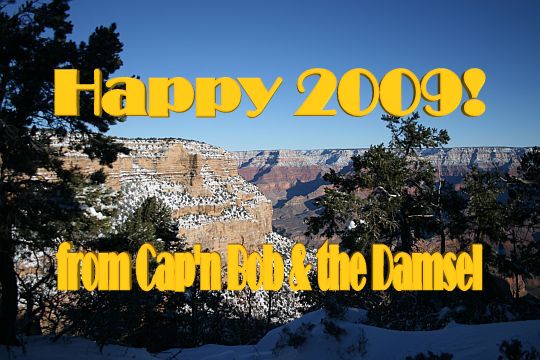
Happy 2009!

We wish the best to you and yours in 2009.

Special Happy New Year wishes to all our veterans, our wounded warriors and active members of the Armed Forces and their families. God speed in the coming year.

canyon-2009.jpg