These beautiful “Freedom” roses make a festive centerpiece on our holiday table. Merry Christmas Everybody!


These beautiful “Freedom” roses make a festive centerpiece on our holiday table. Merry Christmas Everybody!
I promised to show you in a previous post, this beautiful red amaryllis when all eight lovely flowers came out. And just in time for Christmas too!.

 I worry when a large, politically left-leaning enterprise like Google teams up with a government bureaucracy like NASA. True, I support most of the Space Programs, but wonder if this will pan out.
 Google and NASA Ames will focus on making the most useful of NASA’s information available on the Internet. Real-time weather visualization and forecasting, high-resolution 3-D maps of the moon and Mars, real-time tracking of the International Space Station and the space shuttle will be explored in the future.
Well, it sounds like fun, but . . .
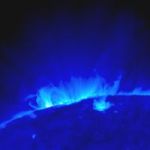 For the first time since its October Launch, the twin-spacecraft STEREO project is producing and sending back images of the Sun. Projects like these are important to understanding the effects of the Sun on our climate and environment. The more that we know about this, the better we are able to further disarm global climate alarmist fantasies about anthropogenic effects.
Image right: A close up of loops in a magnetic active region. These loops, observed by STEREO’s SECCHI/EUVI telescope, are at a million degrees C. This powerful active region, AR903, observed here on Dec. 4, produced a series of intense flares over the next few days. Credit: NASA
Mount St. Helens is showing some activity. This is from the webcam page at Johnston Ridge Observatory.
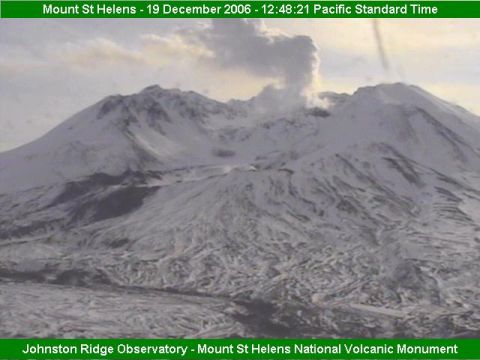
Read the latest geological survey update below the fold.
Some especially intense auroras resulting from solar flares associated with sunspot 930 were visible from outer space via an Air Force satellite. Here’s the story from SpaceWeather.com:
AURORAS FROM SPACE: How bright were the auroras of Dec. 14th? As bright as city lights and easily seen from space. A US Air Force DMSP satellite took this picture from orbit 830 km above the United States:
The bright arc stretching from Montana to Maine is the aurora Borealis. In many places it completely overwhelms the city lights below.
“The DMSP satellite has the ability to detect auroral light at night,” says Paul McCrone of the Air Force Weather Agency at Offutt AFB in Nebraska. “These images are mosaics of various DMSP overflights on Dec. 12-13, Dec. 13-14, and Dec 14-15. The Dec. 14th image is quite striking.”