Travel

Off to Catalina Again

It’s our anniversary week and later today, in our tradition, we’re off on a pilgrimage to the place we got married – the city of Avalon on Catalina Island. We will be crossing the Catalina Channel on the Island Express helicopter, which takes about fifteen minutes. I shot this video last year on the helicopter trip over to the Avalon Heliport.

Our plans are to visit some of our favorite places like the shops on Crescent Avenue and the botanic gardens in the hills behind the town. We plan to do a bit more hiking this time, and will probably climb the hill up to the Chime Tower. We’re looking forward to this trip. We will try and update the blog from the island with some photos and posts about the island.

Pigeon Dung and Reno’s Famous Sign

reno-old.jpgAfter reading news accounts about the contribution of pigeon dung to the collapse of the I-35W bridge in Minneapolis, I was reminded about how pigeons similarly factored into the destruction of the famous “RENO – The Biggest little city in the world” sign that spans the entrance to the downtown gambling district. I recall reading a the story in the 1980’s about how the old sign became inhabited by pigeons that roosted or nested in the sign. They got in through gaps in the sign and, of course, pooped while they were in there.

Image right: Reno sign, 1980’s – click to enlarge

reno-new.jpgEventually, despite having been evicted several times by the city’s maintenance crews, the pigeon problem persisted until one day there was an electrical short-circuit in the sign. The methane from the dung ignited; there was a minor explosion and a fire afterwards that damaged the sign beyond repair. The sign was removed and subsequently replaced by a newer Vegas-style beauty which electronically beckons visitors to the downtown district. While it’s a beautiful sight, the new sign doesn’t have the old sign’s charm and breaks the promise for a “little city” beyond. Recent visitors to the new Reno, if they knew the old Reno, will know what I mean.

Image left: New Reno sign – click to enlarge

As for pigeons? They’re just rats with wings.

Petroglyphs of Canyon de Chelly

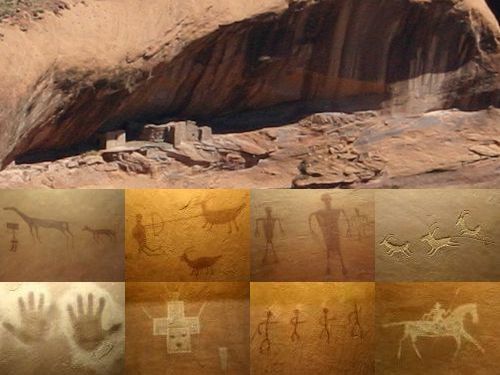
Petroglyphs in the Canyon de Chelly are primitive works of art that span back for centuries. Various peoples have contributed to the collection, including the ancient Anasazi and, more recently the Navajo (Diné) people.

The name Chelly (or Chelley) is a Spanish borrowing of the Navajo word Tséyi’, which meaning “canyon” (literally “inside the rock” < tsé "rock" + -yi' "inside of, within"). The composite image below is a canyon view and several photos of petroglyph reproductions in the Canyon de Chelly National Parks Service Visitor’s Center.

petro-chelly.jpg

Ever-Changing Scenery

scenery.jpg

Last Thursday, we took a rather long drive from Show Low AZ to Chula Vista CA, where we attended Sean Hannity’s Freedom Concert. Along the way, we drove from the White Mountains of Northeastern Arizona, through the canyons and deserts to finally wind up near the southwestern corner of the US. A long drive, indeed, but the scenery is great. If you don’t like the view, just wait five minutes and it will change. Continue reading to see the full-sized slide show of these images.

Continue reading…

Desert View Watchtower

tower.jpgIn 1930, Fred Harvey commissioned Mary Colter to design and build a gift shop and rest area at the Grand Canyon’s Desert View scenic overlook. The Watchtower resulted from Colter’s efforts and was opened to the public in 1933.

The Desert View lookout and the Watchtower make for a climactic final stop if you are driving Desert View Drive from Grand Canyon Village, or a dramatic beginning if you enter the park through the East Entrance. From the top of the 70-foot stone-and-mortar Watchtower even the muted hues of the distant Painted Desert to the east and the 3,000-foot-high Vermilion Cliffs rising from a high plateau near the Utah border are visible. In the chasm below, angling to the north toward Marble Canyon, you can see an imposing stretch of the Colorado River. The Watchtower houses a glass-enclosed observatory with powerful telescopes.

I made the image at the left using a panoramic technique; first, I took three images of the tower in portrait mode, one above the other with slight overlap. Then, I ‘stitched’ them together using a software tool. The camera was my little Canon A710 IS and the photo stitch software was part of Canon’s Zoom Browser package which came with the camera. Click on the thumbnail to see a larger view of this unique tower.