This red rosebud, that is. One of several in a bouquet I got this weekend. We have things that need to be blogged, but working on other stuff today. Meanwhile, enjoy this beautiful red rosebud!
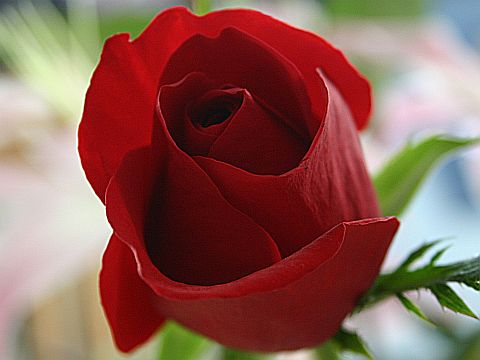

This red rosebud, that is. One of several in a bouquet I got this weekend. We have things that need to be blogged, but working on other stuff today. Meanwhile, enjoy this beautiful red rosebud!
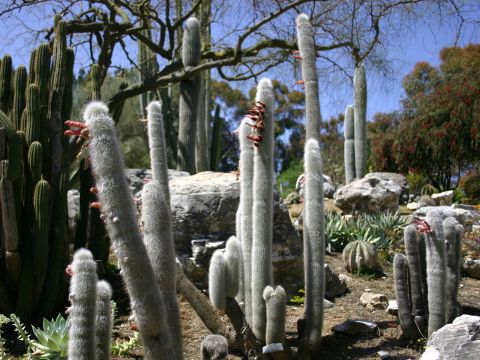
Last weekend we visited the South Coast Botanic Garden, Located on the Palos Verdes Peninsula, Los Angeles County, California. One section of the garden is completely dedicated to various and sundry cactii. I took this shot of some hairy-looking cactus with blossoms.
Cap’n Bob also took a picture of the garden in 3D:

(Click for a larger image – you will need a pair of red/cyan anaglyphic 3D glasses to view in 3D)
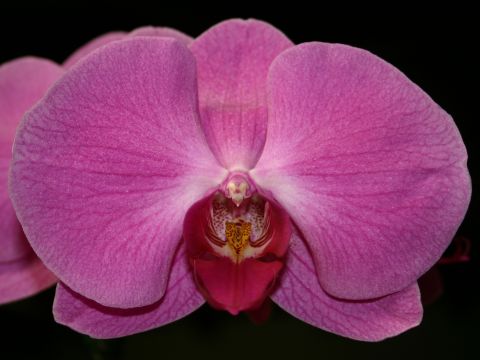
I last sent you a picture of this orchid plant on March 4th. Since then, the orchid plant produced several beautiful flowers which just seem to last and last.
Known as the “moth orchid†due to its resemblance to some tropical moths, the phalaenopsis is native to the Asiatic tropics, India, Indonesia and the Philippines. This lovely and delicate plant is now a welcome adornment to our kitchen counter under the skylight.
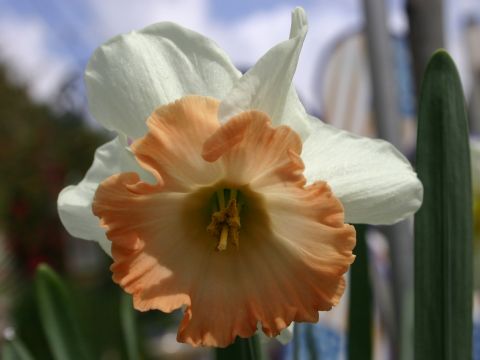
This is a Saint Louie Louie daffodil growing in our garden. Saint Louie Louie daffodils have a wind-swept appearance with a delicate orange trumpet and beautiful creamy-white petals. I think they look fake, but here it is in the garden right in front of me! There is one daffodil bloom per stem, but we had several blooms this year.
This yellow Icelandic Poppy is nicely silhouetted by the little blue flowers in the ground cover underneath. Very pretty.
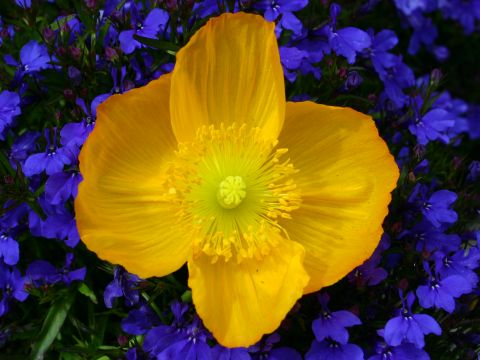
Why do these colors go so nicely together? Looking at a color scheme design tool we use, it shows that indigo-blue and and pale yellow are truly complimentary, as can be seen in the color wheel diagram below.

Our poppies are showing up late this year, perhaps because of the late peaking of the rainy season here. I snapped this picture of a pair of our state flowers in the garden this weekend. Later this month, we’re planning a trip out to the Antelope Valley California Poppy Reserve to enjoy a walk among the fields of poppies and other plant and wildlife.
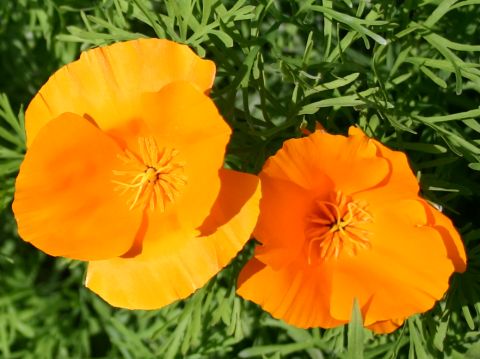
Wikipedia has more information on these flowers:
California Poppy – Wikipedia, the free encyclopedia
The California Poppy (Eschscholzia californica) is native to grassy and open areas from sea level to 2,000m (6,500 feet) altitude in the western United States throughout California, extending to Oregon, southern Washington, Nevada, Arizona, New Mexico, and in Mexico in Sonora and northwest Baja California.It can grow 5-60 cm tall, with alternately branching glaucous blue-green foliage. The leaves are ternately divided into round, lobed segments. The flowers are solitary on long stems, silky-textured, with four petals, each petal 2-6 cm long and broad; their color ranges from yellow to orange, and flowering is from February to September. The fruit is a slender dehiscent capsule 3-9 cm long, which splits in two to release the numerous small black or dark brown seeds. It is perennial in mild parts of its native range, and annual in colder climates; growth is best in full sun and sandy, well-drained, poor soil.
It grows well in disturbed areas and often recolonizes after fires. In addition to being planted for horticulture, revegetation, and highway beautification, it often colonizes along roadsides and other disturbed areas. It is drought-tolerant, self-seeding, and easy to grow in gardens.
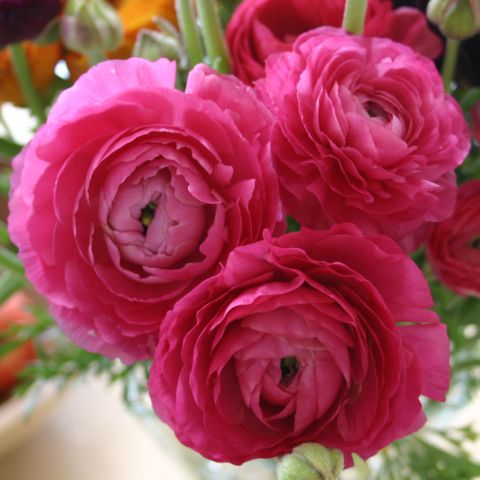
I just love spring. So many flowers and so much color. I got these little beauties at the florist a few days ago and they just seem to be getting prettier.
From www.flowers.org.uk
Ranunculus belong to the Buttercup family and is the cultured cousin of the Marsh Marigold. Its name is from the Latin for little frog. In fairy tales frogs are apt to change into princes and it was an Asian prince in just such a story who gave his name to this flower, which grows naturally in swampy ground. The prince was so good-looking that he was loved by everyone. He also had a beautiful voice but this was his undoing. He loved the open country and sang delightful songs in the presence of nymphs. He did not have the courage to declare his love to them and this haunted him so much that he died. After his death he was changed into the flower with delicate tissuey petals which bears his name.