These three lovely hibiscus flowers were looking very photogenic in the hazy fall sun yesterday. Our back yard still has quite a number of late-fall flowers still blooming.


These three lovely hibiscus flowers were looking very photogenic in the hazy fall sun yesterday. Our back yard still has quite a number of late-fall flowers still blooming.
 I set the small animal trap to try and catch the squirrel that gets in Damsel’s garden and raids the bird feeders. Then this little ‘possum wandered in much to it’s dismay. Not to worry, though, it got released back into the “urban wild” shortly afterwards.
Image courtesy Damsel. Click image for hi-res.
Opossums are probably more beneficial than they are destructive in urban areas. Consider this description from the National Opossum Society:
Opossums help to maintain a clean and healthy environment. They eat all types of insects, including cockroaches, crickets, beetles, et cetera. They catch and eat rats, roof rats, mice, and they consume dead animals of all types (carrion). They like over-ripe fruit, berries, and grapes. And they think snails and slugs are a delicacy! Nature’s little Sanitation Engineers!!
Typically they go about their quiet task late at night, and you usually won’t know they were around…unless your dog (being territorial) starts barking, or you happen to take a midnight stroll when one is munching insects or snails in your yard.
The lighting was just right last Sunday when I took this shot of one of the Cherie Hibiscus blossoms. Evidently, this bush likes the warm weather we had last week and is still delivering these nice flowers daily. This one was especially pretty and had no visible flaws or blemishes.

Found on the Internet from an old Sunset Magazine article:
A warm tropical paradise with gentle ocean breezes is what hibiscus (H. rosasinensis) brings to mind. The state flower of Hawaii, this evergreen hibiscus has long been a symbol of the beauty and lushness of the tropics. If you live in a mild-winter area of the West, you can bring a bit of paradise to your garden by planting hibiscus.
We went to the Botanic Gardens today for a mum show and sale. As usual, we also walked out into the gardens. Not far from the Red and White Dahlia I previously posted, we saw this dahlia variety that reminded me of a fireworks skyburst. Click on the image for a larger view.

After this week’s Monday blues, we both needed to think some happy thoughts. We were upset with Arnold, political shenanigans in congress, media lies and news suppression and mass hysteria over the climate non-problem. You know – the usual.
Take a deep breath and enjoy these prize-winning phalaenopsis orchids. Woooo-saaaa . . .

Click the pic for big.
 I saw this orange cymbidium orchid at the Botanic Gardens plant sale last Saturday, and thought it was very nice. Since it was one of the first things to be seen inside the courtyard as we entered the show and sale, I put it aside and we went to look at the rest of the exhibits in the courtyard and showroom.
After cruising the exhibits a bit, Damsel bought an interesting succulent for the front flowerbed. We then went out into the garden area and took a very long walk through the volunteer garden, past the cactus patch and all the way to the lake where I took the picture of the Ruby Meadowhawk.
On our way back from the lake, I couldn’t stop thinking about the orange cymbidium, and so I decided to buy it. It already has the beautiful flowers shown, and numerous stalks and pods that promise that we should have more of these in a while. Damsel took this picture after we got it home and in the patio. Click on the image for the very large view.
All the years that I have been in California, it was not until last weekend that I saw a red dragonfly. In fact, there were red dragonflies in abundance, around the lake at the South Coast Botanic Gardens. This is one of those infrequent occasions where I got an outstanding picture (Damsel is the queen of artistic photos in our family).
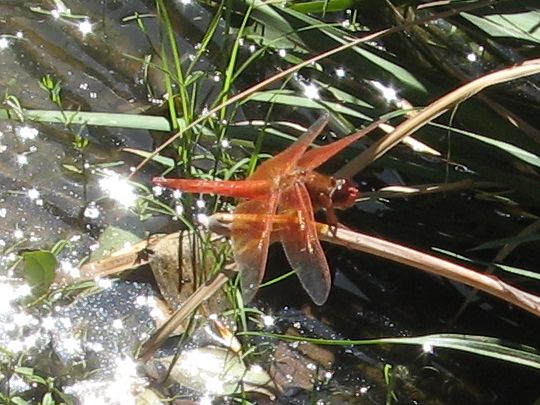
I did some research and found out that this is a Ruby Meadowhawk, a variety of the suborder Anistoptera (Dragonfly). This is an excerpt from the WikiPedia page on Dragonflies:
Dragonflies typically eat mosquitoes, midges and other small insects like flies, bees, and butterflies. They are usually found around lakes, ponds, streams, and wetlands because their larvae, known as “nymphs”, are aquatic. Dragonflies do not normally bite or sting humans (though they will bite in order to escape, for example, if grasped by the abdomen); in fact, they are valued as a predator that helps control the populations of harmful insects, such as mosquitoes. It is because of this that dragonflies are sometimes called “mosquito hawks.”