Planet Mercury in the Twilight

If you step out this evening or or tomorrow evening, you might catch a glimpse of the seldom-seen planet – Mercury. Known as the Incredible Shrinking Planet, Mercury is about to slip back out of sight as it disappears behind the Sun until it emerges later this year.

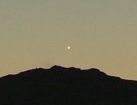
Right: Mercury over the Rockies as seen from Denver – Credit: Jeffrey Beall.

Meanwhile, a little known NASA mission – MESSENGER – got a boost from it’s thrusters to place it on trajectory for another gravity-assisted sling around planet Venus toward it’s ultimate goal of orbiting the closest planet to the sun.

New Scientist has some information about NASA’s MESSENGER mission:

Messenger probe nudged towards Venus flyby

NASA’s first mission to Mercury in more than 30 years completed its final trajectory correction manoeuvre on Wednesday before a flyby of Venus in October 2006.

Messenger – short for Mercury, Surface, Space Environment, Geochemistry and Ranging – is on a 7.9 billion kilometre path to becoming the first spacecraft to orbit Mercury.

Note: words in the New Scientist article are spelled correctly – at least in the UK where the magazine is based.

Damsel Sends You Catalina Island

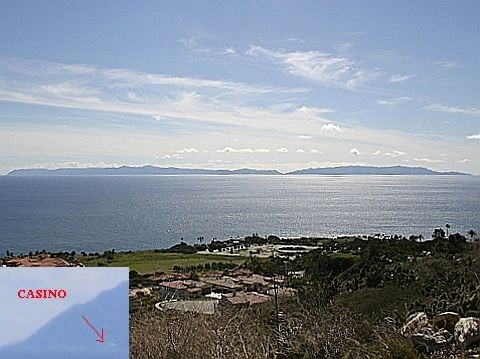
This is a nice wide shot of the entire island of Catalina. The island is about 22 miles from end to end, and that entire span is visible in this view. This shot was made from a vantage point on the Palos Verdes Peninsula at elevation 800 feet above sea level. It was so clear that day, we could see Santa Barbara Island at a distance of 40 or so miles to the west. The view of Catalina was so clear that we could discern the famous Casino at the far east (left) end of the island with the naked eye from the mainland. You can see it as a white speck in the inset from another photo taken without a telephoto lens.

Roundabouts

Retired Geezer at Blog Idaho put out this article on a traffic circle being proposed for Nampa County; the Geezer says:

Blog Idaho: Roundabouts: Good or Bad?

A Roundabout is a traffic circle that replaces an intersection. They are popular in Europe, which should be enough to make me question their value.

I don’t remember hearing anything positive about them from friends who had them installed in their neighborhoods. I think their complaint was that when trucks got in the middle, they had trouble getting out safely. Here in I-Dee-Ho, we have trucks pulling 2 and 3 trailers.
Not to mention ungainly farm equipment.

How about all you Big-City-Folks telling us what you think.

Don’t do it! you might wind up with a circle-jerk like this one in Long Beach, California:

Long Beach Traffic Circle – Google Maps

Damsel and I just HATE to drive through that mess, and avoid it if we can. We hated driving in Washington, D.C. for the same reason.

Stars – Celestial vs. Celebrity

Caving into the almighty quest for capital, a famous London company will shut down a popular planetarium & science exhibit in favor of shows featuring celebrities. In essence, celestial stars are out, superficial stars are in.
From Sky and Telescope: London Planetarium to Close

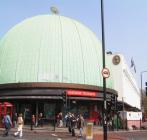
February 22, 2006 The stars at one of central London’s well-known tourist attractions will go dark for good this July. Madame Tussauds waxworks, the owner of the London Planetarium, has decided to close the facility as the company shifts its focus from science education to entertainment. The planetarium (renamed the Auditorium) will soon replace its shows with programs about celebrities.

Built in the 1950s, the London Planetarium seats around 330 under its green 18-meter (60-foot) dome. Although Madame Tussauds had cut the screenings of its shows to just one 10-minute program called “Journey to Infinity,” the planetarium has remained very popular with local schoolchildren and their teachers.

“The London Planetarium has inspired generations of schoolchildren,” notes Robin Scagell, vice president of Britain’s Society for Popular Astronomy. “Many parents can still remember their first visit to it when they were young. To lose the planetarium now would be a tragedy.”

The Royal Observatory’s new, state-of-the-art 120-seat planetarium in Greenwich Park, about 30 minutes from downtown London by boat or rail, is currently under construction and won’t be completed until early 2007. “The only other planetarium of any size within striking distance of London,” says Scagell, “is the South Downs Planetarium near Chichester on the South Coast, about 60 miles from the capital, which is certainly not readily accessible unless you happen to be in the area.”

“I don’t think the Madame Tussauds management wants to sell or lease out the London Planetarium,” he adds. “It’s a valuable bit of real estate in a very expensive part of the world, and I’m sure they want to hang on to it. The dome itself is not a listed building, that is, not protected as being of historic or architectural value, but I doubt that they would want to pull it down just yet.”

It’s a shame to trade science for sensationalism. Most celestial stars are in their main sequence and will glow for billions of years to come. Terrestrial stars might be compared to final sequence giant stars, which have only a short time left before they collapse into the dwarfs they are all destined to become.

Washington’s Birthday

Today is the 274th anniversary of the birth of George Washington.

From WikiPedia:

George Washington (February 22, 1732 – December 14, 1799)

George Washington was the successful Commander-in-Chief of the Continental Army in the American Revolutionary War from 1775 to 1783, and later became the first President of the United States, an office to which he was elected, unanimously, twice and remained in from 1789 to 1797. Washington first gained prominence as an officer during the French and Indian War and as a leader of colonial militia supporting the British Empire. After leading the American victory in the Revolutionary War, he refused to lead a military regime, though encouraged by some of his peers to do so. He returned to civilian life at Mount Vernon.

In 1787, he presided over the Constitutional Convention that drafted the current United States Constitution, and, in 1789, was the unanimous choice to become the first President of the United States. His two-term administration set many policies and traditions that survive today. After his second term expired, Washington again voluntarily relinquished power, thereby establishing an important precedent that was to serve as an example for the United States and also for other future republics.

Because of his central role in the founding of the United States, Washington is often called the “Father of his Country”. Scholars rank him with Abraham Lincoln among the greatest of United States presidents.