California Poppies

Our poppies are showing up late this year, perhaps because of the late peaking of the rainy season here. I snapped this picture of a pair of our state flowers in the garden this weekend. Later this month, we’re planning a trip out to the Antelope Valley California Poppy Reserve to enjoy a walk among the fields of poppies and other plant and wildlife.

Wikipedia has more information on these flowers:

California Poppy – Wikipedia, the free encyclopedia
The California Poppy (Eschscholzia californica) is native to grassy and open areas from sea level to 2,000m (6,500 feet) altitude in the western United States throughout California, extending to Oregon, southern Washington, Nevada, Arizona, New Mexico, and in Mexico in Sonora and northwest Baja California.

It can grow 5-60 cm tall, with alternately branching glaucous blue-green foliage. The leaves are ternately divided into round, lobed segments. The flowers are solitary on long stems, silky-textured, with four petals, each petal 2-6 cm long and broad; their color ranges from yellow to orange, and flowering is from February to September. The fruit is a slender dehiscent capsule 3-9 cm long, which splits in two to release the numerous small black or dark brown seeds. It is perennial in mild parts of its native range, and annual in colder climates; growth is best in full sun and sandy, well-drained, poor soil.

It grows well in disturbed areas and often recolonizes after fires. In addition to being planted for horticulture, revegetation, and highway beautification, it often colonizes along roadsides and other disturbed areas. It is drought-tolerant, self-seeding, and easy to grow in gardens.

A Bathtub Analogy to Illegal Immigration

Here’s some fluid advice from California Congressman Dana Rohrabacher (R):

Republican congressman offers immigration solution

By Dana Rohrabacher

If a bathtub is overflowing and water is spilling onto the floor, the first thing most rational people would do is turn off the faucet, remove the tub stopper and let the water drain. Then the cleanup would begin. If only the federal government was as rational.


Unfortunately, there are many in Congress who would mop up the floor before turning off the faucet and draining the tub. Instead of turning off the massive flow of illegal aliens in our country and demonstrating that the government can keep that flow at a very low trickle, Congress is proposing to legalize the millions of illegal aliens in the country first. This strategy has not worked in the past and it will not work for our country now.

There is only one way to stop this unfettered flow of illegal immigrants: cut off the jobs and benefits that attract them to America. The federal government must demand that businesses verify the legal status of their employees and administer heavy fines to those who violate the law and hire illegal aliens.

[read more]


Rohrabacher used to be our congressman before the Democrats in California Gerrymandered my Republican ass into Jane Harman’s District. We had actual rational representation up until then. Now, we have a congressperson who prioritizes Rowe v. Wade above National Security and Immigration Enforcement.

Three Years In Iraq

Critics of Operation Iraqi Freedom often allege that little or no progress has been made since the invasion. The Secretary of Defense, the Honorable Donald Rumsfeld, has written an excellent article about our progress and addresses critics’ allegations.

From CENTCOM:

What We’ve Gained In Three Years In Iraq

By Donald H. Rumsfeld

Some have described the situation in Iraq as a tightening noose, noting that “time is not on our side” and that “morale is down.” Others have described a “very dangerous” turn of events and are “extremely concerned.”

Photo by Capt. Joe Vanty, 138th MPAD, US Army Reserve – Young children watch as U.S. Soldiers from Alaska’s 172nd Stryker Brigade Combat Team pass by.

Who are they that have expressed these concerns? In fact, these are the exact words of terrorists discussing Iraq — Abu Musab al-Zarqawi and his associates — who are describing their own situation and must be watching with fear the progress that Iraq has made over the past three years.

The terrorists seem to recognize that they are losing in Iraq. I believe that history will show that to be the case.

Fortunately, history is not made up of daily headlines, blogs on Web sites or the latest sensational attack. History is a bigger picture, and it takes some time and perspective to measure accurately.

Consider that in three years Iraq has gone from enduring a brutal dictatorship to electing a provisional government to ratifying a new constitution written by Iraqis to electing a permanent government last December. In each of these elections, the number of voters participating has increased significantly — from 8.5 million in the January 2005 election to nearly 12 million in the December election — in defiance of terrorists’ threats and attacks.

[read more]

West Beaches

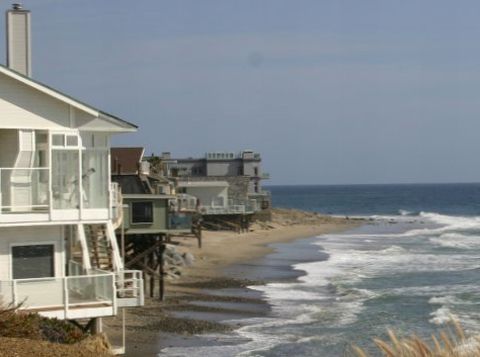
There are miles and miles of scenic beaches in western Los Angeles County. During our recent excursion to the Ronald Reagan Presidential Library, we took the time to return via the shoreline. I snapped these pictures as we passed beautiful beaches and homes.

This is a shot of Zuma Beach with Point Dume in the distance.

These beach front homes are just west of Malibu – I wonder how much these guys have to pay per year for tsunami insurance? Can one even get tsunami insurance?

Magnetic Moondust

A while back, I referenced a story about moondust smelling like gunpowder. Now, it seems, moondust has magnetic properties as well. Each tiny grain of dust contains a few iron particles. The iron’s magnetic properties allow the smallest dust particles to be swept up by magnets. This is a key discovery for NASA engineers who want to return manned expeditions to the lunar surface where dust has plagued the seals of space suits and contaminated mineral samples and just about everything else. Even astronaut Gene Cernan was a moondust mess after a surface excursion (see picture).

NASA – Magnetic Moondust

April 4, 2006: Thirty-plus years ago on the moon, Apollo astronauts made an important discovery: Moondust can be a major nuisance. The fine powdery grit was everywhere and had a curious way of getting into things. Moondust plugged bolt holes, fouled tools, coated astronauts’ visors and abraded their gloves. Very often while working on the surface, they had to stop what they were doing to clean their cameras and equipment using large–and mostly ineffective–brushes.

Dealing with “the dust problem” is going to be a priority for the next generation of NASA explorers. But how? Professor Larry Taylor, director of the Planetary Geosciences Institute at the University of Tennessee, believes he has an answer: “Magnets.”

[read more]