And, on an astronomical scale, it IS huge! We reported in a previous article, See Spot Run about the two red spots on Jupiter, Great Red and Red, Jr. Time to get the backyard telescope out and get it tuned up for this!
June 5, 2006: The two biggest storms in the solar system are about to go bump in the night, in plain view of backyard telescopes.
Storm #1 is the Great Red Spot, twice as wide as Earth itself, with winds blowing 350 mph. The behemoth has been spinning around Jupiter for hundreds of years.
Storm #2 is Oval BA, also known as “Red Jr.,” a youngster of a storm only six years old. Compared to the Great Red Spot, Red Jr. is half-sized, able to swallow Earth merely once, but it blows just as hard as its older cousin.
[more]

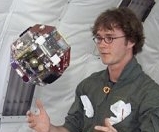 Six years ago, MIT engineering Professor David Miller showed the movie Star Wars to his students on their first day of class. There’s a scene Miller is particularly fond of, the one where Luke Skywalker spars with a floating battle droid. Miller stood up and pointed: “I want you to build me some of those.”

 To better understand that question, we must discuss oxygen. Earth’s atmosphere is composed of 78% nitrogen, 21% oxygen and 1% “other gasses” which include water vapor, carbon dioxide and ozone. Included in the latter 1% is the dreaded “greenhouse gasses” you hear about. Less than one percent of the atmosphere is causing all that “trouble” — hmmmm. I digress — Back to oxygen . . .