Assemblyman Ted Lieu – Greenbat

lieu-mug.jpgOur Democratic State Assemblyman, Ted Lieu, California 53rd District, is distributing an invitation to hear one of Al Gore‘s minions expound on the Inconvenient Truth at a town hall meeting.

I emailed Assemblyman Lieu and got no response to my invitation for him to take advantage of the Climate and Global Warming Resources on this website as well as the numerous resources therein.

Given the political nature of the climate debate, I ask if it’s appropriate for this to be funded by the State of California and the City of Torrance?

Images from Lieu’s Webpage.

Here’s a portion of Lieu’s flyer:

Continue reading…

Attention Gun Owners

I would chime in on this even if I lived outside of California. Arnold Schwarzenegger may be considering national politics and could care what you think:

Just in from the NRA:

Attention California Gun Owners:
Please Contact Governor Schwarzenegger Today!

Three pieces of firearm-related legislation are currently on the desk of Governor Arnold Schwarzenegger (R) awaiting his consideration.

Assembly Bill 1471 would require that after a certain date, the make, model, and serial number of a firearm be microstamped onto the interior surface or internal working parts of all handguns in such a manner that those identifiers are imprinted onto the cartridge case upon firing. The manufacture, sale, and transfer of handguns that do not imprint their identifying information on a cartridge case would be a crime.

Assembly Bill 821 would ban the use of lead ammunition for hunting in areas occupied by California condor. By passing AB 821, the Legislature has usurped the authority of the Fish and Game Commission over the regulation of hunting and the management of the state’s wildlife. Unlike the Fish and Game Commission, the Legislature did not take into account the effects of a lead ammunition ban on the state’s hunters. Studies show that a ban will force many hunters to quit hunting altogether having catastrophic consequences on wildlife management practices and the state’s hunting heritage.

Assembly Bill 1645 will protect law-abiding gun owners during a declared state of emergency from the seizure or confiscation of any lawfully carried or possessed firearm or ammunition.

Please contact the Governor and respectfully urge him to veto AB1471 and AB821. Also remind him to protect your Second Amendment rights during a state of emergency by signing AB1645. Governor Schwarzenegger can be reached by phone at (916) 445-2841, fax at (916) 445-4633, or visit http://gov.ca.gov/interact#email to send him an email.

A New Cymbidium Orchid

new-cymbidium.jpgI saw this orange cymbidium orchid at the Botanic Gardens plant sale last Saturday, and thought it was very nice. Since it was one of the first things to be seen inside the courtyard as we entered the show and sale, I put it aside and we went to look at the rest of the exhibits in the courtyard and showroom.

After cruising the exhibits a bit, Damsel bought an interesting succulent for the front flowerbed. We then went out into the garden area and took a very long walk through the volunteer garden, past the cactus patch and all the way to the lake where I took the picture of the Ruby Meadowhawk.

On our way back from the lake, I couldn’t stop thinking about the orange cymbidium, and so I decided to buy it. It already has the beautiful flowers shown, and numerous stalks and pods that promise that we should have more of these in a while. Damsel took this picture after we got it home and in the patio. Click on the image for the very large view.

Ruby Meadowhawk Dragonfly

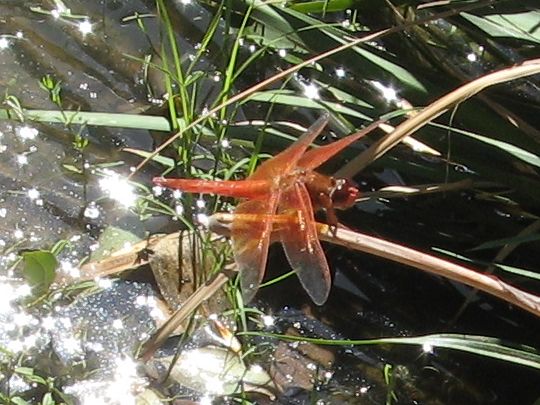
All the years that I have been in California, it was not until last weekend that I saw a red dragonfly. In fact, there were red dragonflies in abundance, around the lake at the South Coast Botanic Gardens. This is one of those infrequent occasions where I got an outstanding picture (Damsel is the queen of artistic photos in our family).

ruby-meadowhawk

I did some research and found out that this is a Ruby Meadowhawk, a variety of the suborder Anistoptera (Dragonfly). This is an excerpt from the WikiPedia page on Dragonflies:

Dragonflies typically eat mosquitoes, midges and other small insects like flies, bees, and butterflies. They are usually found around lakes, ponds, streams, and wetlands because their larvae, known as “nymphs”, are aquatic. Dragonflies do not normally bite or sting humans (though they will bite in order to escape, for example, if grasped by the abdomen); in fact, they are valued as a predator that helps control the populations of harmful insects, such as mosquitoes. It is because of this that dragonflies are sometimes called “mosquito hawks.”

Hummingbird and Chinese Lantern

Little hummingbirds like this one like to browse the puffy flowers of the Chinese Lantern Bush at the Botanic Garden. I walked up to within five feet of this one and snapped this photo before it flitted away. Cute little thing – about three inches in length.

hummingbird

Shotgun Still Life

After today’s session at the range, we set the guns out for cleaning as usual. I like to take a picture of the guns we took each time we shoot, just for the record. We don’t take all the guns on a given day. I handed my little Canon PowerShot A510 to Damsel while I was opening the tool box, and she took this nice perspective picture of the shotguns awaiting clean-up.

She just seems to have the artistic flair with the camera, while I’m just a mere photo journalist most of the time. I guess I can deal with that.

gun-pron.jpg

A Red and White Dahlia

red-white-dahlia.jpgToday we will be going back to the South Coast Botanic Garden for a plant sale and to visit the rest of the garden.

One of the prettiest flowers growing in the Garden is this striking red and white Dahlia. I took this picture last week at the orchid show. Click for the big picture (which hardly does this beautiful flower justice – you had to be there).

Here are some interesting facts about Dahlias:

Aztecs collected or cultivated Dahlias as early as the 15th century. Flowers were depicted in cave drawings and hieroglyphics credited to the Aztecs of the 14th and possibly of the 13th century. It was used as a religious symbol and for medicinal and cultural rather than aesthetic purposes. Dahlia tubers were an important food source for the Aztecs indeed to this day. the Indians of central Mexico rely on the tubers as a valuable part of their diet. It was woven into clothing for the Royal family, warriors shields, breast plates, necklaces, etc.

The first encounter by other than the peoples of Mexico seems to be well established as made by a Spanish citizen, Francisco Hernandez who was sent to Mexico in 1570 to investigate the “natural resources of “New Spain.” The first published pictures were drawings by an Hidalgo Gentleman, Francisco Dominguez who accompanied Hernandez on at least some part of his explorations. Both the report and drawings were published at Rome, but not until 1651, about seventy five years after first produced. Prior to publication the report was translated to Latin, and later to English. Little recorded information is found concerning the next 126 years.

(Source: dahlia.org.)