Highlights From the D.C. vs. Heller Oral Arguments

Here are some comments from a couple of folks after oral arguments in the landmark second amendment D.C. vs. Heller case before the Supreme Court earlier this week. The case is a challenge by the District of Columbia to overturn a ruling by a federal court that their total ban on handgun ownership is unconstitutional.

NRA Vice President Wayne LaPierre was in attendance:

I was at the Supreme Court [Tuesday], and based on what I heard, I have every expectation that the Court will soon restore the Second Amendment to the District of Columbia.

Everything I saw in court shows the District’s ban on functional firearms is out of sync with American history. The arguments today clearly indicated the Second Amendment is an individual, and not a collective, right. The District’s attorneys spent their time swimming upstream against the U.S. Constitution.

Alan Gura, attorney for Heller et al, made these comments in response to criticism about his remarks regarding continuing the ban on machine guns:

The solution to 922(o) will have to be political in the end. The fact is, outside the gun community, the concept of privately owned machine guns is intolerable to American society and 100% of all federal judges. If I had suggested in any way — including, by being evasive and indirect and fudging the answer — that machine guns are the next case and this is the path to dumping 922(o) — I’d have instantly lost all 9 justices. Even Scalia. There wasn’t any question of that, at all, going in, and it was confirmed in unmistakable fashion when I stood there a few feet from the justices and heard and saw how they related to machine guns. It was not just my opinion, but one uniformly held by ALL the attorneys with whom we bounced ideas off, some of them exceedingly bright people. Ditto for the people who wanted me to declare an absolute right, like I’m there to waive some sort of GOA bumper sticker. That’s a good way to lose, too, and look like a moron in the process.

I think Heller got himself a pretty good attorney.

Finally, there is this viewpoint shared by anti-second amendment gun haters:

right side of the court

It looks like the no-gunners are running scared.
Kaffir Lilies

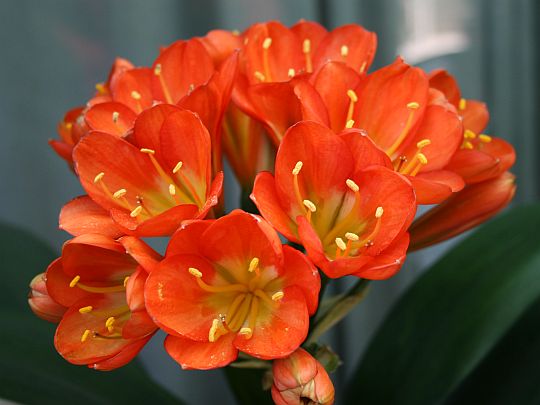
It’s that time of the year when these brilliant Kaffir Lilies are seen all over the area. We’re no exception, since we got this one last year at the local shrubbery emporium.

Kaffir Lilies

Tuscan Blue Rosemary

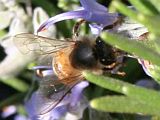
beeThe popular herb Rosemary is also commonly used as a decorative shrub and as topiary. It is native to the Mediterranean but also does well in Southern California. The Rosemary name has nothing to do with Rose or Mary – it comes from the Latin name for the shrub which literally means ‘dew of the sea.’ Rosemary has a reputation as a remedy for various ailments and is said to improve memory.


We have several bushes in the back yard which give us a year-round supply of the herb for the kitchen and other culinary uses – we use the thicker woody stems as skewers for shish-kebabs. Sometimes we will throw some Rosemary stems in the barbecue to add flavor to grilled chicken, pork or beef.

If you look closely at the little blue flowers, you will see a very pretty pattern that resembles an iris or similar flower. Of course, the bees are attracted to the flowers too as seen in the image above.

Click on the image below for a very big picture.

blue tuscan

Camera: Canon EOS 400D Rebel XTi, EF-S 18-55mm, f3.5-5.6 zoom lens.

Not Exactly an Irish Setter

Bear celebrated St. Patrick’s Day by briefly posing with this shamrock headgear. I say briefly because each time I put this on her, she would quickly manage to get it off.

not an irish setter

A Red and White Tulip

red-white-tulip.jpgEarly spring bulbs bring color and beauty to the garden. This tulip, freshly spritzed, is no exception. Click on the image for larger.

From Wikipedia:

Tulips originate from mountainous areas with temperate climates and need a period of cool dormancy. They do best in climates with long cool springs and early summers, but they are often grown as spring blooming annual plantings in warmer areas of the world. The bulbs are typically planted in late summer and fall, normally from 10 to 20 cm (4 to 8 in.) deep, depending of the type planted, in well draining soils. In parts of the world that do not have long cool springs and early summers, the bulbs are often planted up to 12 inches deep, this provides some protection from the heat of summer and tends to force the plants to regenerate one large bulb each year instead of many smaller non blooming ones. This can extend the usefulness of the plants in warmer areas a few years but not stave off the degradation in bulb size and eventual death of the plants.

March 14 – PI Day

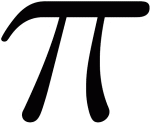
pi.gifIn keeping with the last nerdy post about mathematics, I would like to wish you a happy PI (3.14..) day! In my career in aerospace and also as a pilot and flight instructor, I use the quantity PI (approximately equal to 3.14159265) for all kinds of engineering and navigation applications.

In the excerpt below is the notion that you can approximate the value of PI by throwing needles or frozen hot dogs. Don’t laugh, it works – a group of us a long time ago in a lab at work performed the experiment using tongue depressors. The method uses the laws of probability to approximate PI when you divide the number of throws by the number of times a tossed object crosses one of the reference lines. The lines are set at intervals equal to the length of the objects being thrown.

From SpaceWeather.com

HAPPY PI DAY: March 14th (3.14) is PI day and all around the world mathematicians are celebrating this compelling and mysterious constant of Nature. PI appears in equations describing the orbits of planets, the colors of auroras, the structure of DNA. It’s everywhere.

Humans have been struggling to calculate PI for thousands of years. Divide the circumference of a circle by its diameter; the ratio is PI. Sounds simple, but the devil is in the digits. While the value of PI is finite (a smidgen more than 3), the decimal number is infinitely long:

3.1415926535897932384626433832795
02884197169399375105820974944592307
81640628620899862803482534211706…more

Supercomputers have succeeded in calculating PI to more than 200 billion digits and they’re still crunching. The weirdest way to compute PI: throw needles at a table or frozen hot dogs on the floor. Party time!