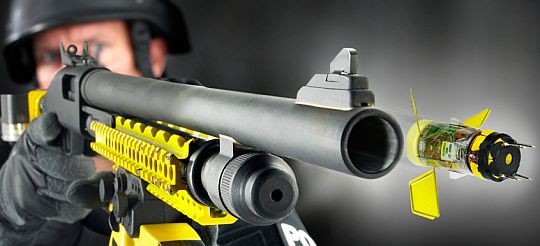
TASER XREP Shotgun Stun Projectile

While a TASER XREP might be a good non-lethal solution to a home invader, I would recommend the next round in the magazine to be a standard 12-gauge double-ought round – Just in case.

Taser XREP

How Stuff Works has a new article on this interesting technology.

Creating a device small enough to fit into a shotgun shell casing but powerful enough to incapacitate a subject was no easy task. The development team at TASER had to find a way to balance power with size. Not only did they need the device to travel farther than a standard TASER, but also to have the right amount of mass. If it had too little mass, it wouldn’t travel far enough. But if it had too much mass, it could become a deadly projectile rather than a non-lethal solution.

UPDATE: This has nothing to do with this post, but deserves your attention. Gun Rights Examiner has details about a teacher getting suspended for having a picture on Facebook while holding a gun. Recommended reading for sure.

California DMV Rollback

dmv.jpgGovernor Terminator terminates DMV services a couple of days a week to ‘save money.’

All Department of Motor Vehicles offices will close the first and third Fridays of each month by order of the governor.

The action begins this week under the Governor’s Executive order, addressing the state’s $42 billion deficit and ongoing financial crisis, the DMV said today.

DMV officials encouraged customers to schedule advance appointments and use services available on the DMV’s Internet website at www.dmv.ca.gov

Motorists whose registration renewal date falls on a furlough day will have penalties waived until the next business day, officials said.

I can think of a lot of useless state give-aways he could terminate to save money without shutting down public services. Also, the DMV, like the USPS would probably do better if administered by private enterprises that actually make a profit from the businesses.

Boxer’s Greenbat Agenda and Inhofe’s Reaction

The Senate Committee on Environment and Public Works Chair is Democratic California Senator Barbara Boxer; the ranking committee member is Republican Oklahoma Senator James Inhofe. Recently, Boxer put forth a list of “principles” to address “Global Warming.” Inhofe, as usual, answered Boxer’s crazy shopping list with some sensible remarks.

Typical of the contents of the Democratic Platform, Boxer and her committee Democrats put forth the following rambling, nebulous list of ‘principles:’

  • To reduce emissions “to levels guided by science to avoid dangerous global warming” and to set targets that are “certain and enforceable,” as well as adjustable.
  • To maintain state and local anti-warming efforts.
  • To utilize a market-based system — that means cap-and-trade, as opposed to a carbon tax, which some economists favor to reduce emissions.
  • To use proceeds from the sales of emissions permits for a variety of uses, including: support for consumers, governments, businesses and workers (presumably to help offset higher energy prices under the system); investments in alternative energy; preserving wildlife and ecosystems threatened by warming; and money for developing nations to help them respond to warming.
  • To ensure a “level global playing field … so that countries contribute their fair share to the international effort to combat global warming.

Senator Inhofe responded with frankness and reality, in stark contrast to the vague list above:

“At a time when Congress is debating a near-term multi-billion-dollar bailout for the American economy, once again the Democrats are proposing principles for climate legislation that will impose a long-term multi-trillion-dollar energy tax on families and workers,” he said.

“As demonstrated last year, when it comes to drafting comprehensive climate legislation, the devil is in the details. These principles offer nothing more than a punt on all of the difficult issues that Americans expect to be honestly debated. Congressional cap-and-trade bills, often touted as an ‘insurance policy’ against global warming, would instead be nothing more than all economic pain for no climate gain. We look forward to debating these tough issues in the Committee this year.”

The emphasis above is mine.

911 Scam Alert – Be Aware of “SWATTING”

swatEvery homeowner with firearms in the home may want to pay close attention to this – a new 911 scam that exploits a weakness in the internet telephone system has been sending first responders, usually S.W.A.T. teams, to random phony emergency calls. If this happens to you, be very careful what actions you take.

The scene below takes place after 10 PM in a suburban neighborhood. A homeowner and his family are awakened by loud sirens, footsteps and a helicopter orbiting above.

The family has been SWATTED.

Doug Bates got up to lock the doors and grabbed a knife. A beam from a flashlight hit him. He peeked into the backyard. A swarm of police, assault rifles drawn, ordered him out of the house. Bates emerged, frightened and with the knife in his hand, as his wife frantically dialed 911. They were handcuffed and ordered to the ground while officers stormed the house.

The scene of mayhem and carnage the officers expected was nowhere to be found. Neither the Bateses nor the officers knew that they were pawns in a dangerous game being played 1,200 miles away by a teenager bent on terrifying a random family of strangers.

Bates said that if he had responded with a gun that he feared he would have been shot.

With that in mind, if that ever happens in your neighborhood, keep it cool with the personal armed response. Remember, we keep our guns handy just in case of a 911 emergency where the police can’t respond in time, but NOT if they’ve surrounded your house.

Read the report “New 911 fraud is duping SWAT teams.”

Range Report

This week we took the following firearms to the range: Para Warthog (.45 ACP), S&W 908 (9mm), S&W 442 (.38 SPL), and the Glocks – G26 (9mm) and G30 (.45 ACP). We also brought Remington 870 shotguns – a 20 gauge ‘youth model’ and a 7-shot ‘security gun.’

This was the day for misfeeds, I guess. The Para, which had been working mostly flawlessly the last several outings, suddenly had numerous misfeeds. Nothing serious and a little lube fixed it for the most part. It happened using the same ammo and under all the same conditions as before. The biggest peculiarity today was the Glock 30 had a misfeed. Move your cursor over the image above to see the Glock 30 with a round stuck halfway into the chamber.

We had a pretty busy day today. We wanted to get our target practice session in before coming home to enjoy the Superbowl festivities. After shooting, we religiously clean up the firearms and get everything ready for the next shootout. In addition to the fun chores, the lawn needed to be mowed. But, we managed to get everything done and were ready to sit down and enjoy the big game.

Congratulations to the Pittsburgh Steelers on their Superbowl XLIII victory.

The National Right-to-Carry Reciprocity Bill

Please be sure to contact your U.S. Representative at (202) 225-3121, and urge him or her to cosponsor and support H.R. 197!

NCCWH.R. 197, introduced in the U.S. House by Representatives Cliff Stearns’ (R-Fla.) and Rick Boucher (D-Va.), would allow any person with a valid concealed firearm carrying permit or license, issued by a state, to carry a concealed firearm in any state, as follows: In states that issue concealed firearm permits, a state’s laws governing where concealed firearms may be carried would apply within its borders. In states that do not issue carry permits, a federal “bright-line” standard would permit carrying in places other than police stations; courthouses; public polling places; meetings of state, county, or municipal governing bodies; schools; passenger areas of airports; and certain other locations. The bill applies to D.C., Puerto Rico and U.S. territories. It would not create a federal licensing system; it would require the states to recognize each others’ carry permits, just as they recognize drivers’ licenses and carry permits held by armored car guards. Rep. Stearns has introduced such legislation since 1995.

• Today, 48 states have laws permitting concealed carry, in some circumstances. Forty states, accounting for two-thirds of the U.S. population, have RTC laws. Thirty-six have “shall issue” permit laws (including Alaska, which also allows carrying without a permit), three have fairly administered “discretionary issue” permit laws, and Vermont (and Alaska) allow carrying without a permit. (Eight states have restrictive discretionary issue laws.) Most RTC states have adopted their laws in the last decade.

• Citizens with carry permits are more law-abiding than the general public. Only 0.01% of nearly 1.2 million permits issued by Florida have been revoked because of firearm crimes by permit holders. Similarly low percentages of permits have been revoked in Texas, Virginia, and other RTC states that keep such statistics. RTC is widely supported by law enforcement officials and groups.

• States with RTC laws have lower violent crime rates. On average, 22% lower total violent crime, 30% lower murder, 46% lower robbery, and 12% lower aggravated assault, compared to the rest of the country. The seven states with the lowest violent crime rates are RTC states. (Data: FBI.)

• Crime declines in states with RTC laws. Since adopting RTC in 1987, Florida’s total violent crime and murder rates have dropped 32% and 58%, respectively. Texas’ violent crime and murder rates have dropped 20% and 31%, respectively, since its 1996 RTC law. (Data: FBI.)

• The right of self-defense is fundamental, and has been recognized in law for centuries. The Declaration of Independence asserts that “life” is among the unalienable rights of all people. The Second Amendment guarantees the right of the people to keep and bear arms for “security.”

• The laws of all states and constitutions of most states recognize the right to use force in self-defense. The Supreme Court has stated that a person “may repel force by force” in self-defense, and is “entitled to stand his ground and meet any attack made upon him with a deadly weapon, in such a way and with such force” as needed to prevent “great bodily injury or death.” (Beard v. U.S., 1895)

• Congress affirmed the right to guns for “protective purposes” in the Gun Control Act (1968) and Firearm Owners’ Protection Act (1986). In 1982, the Senate Judiciary Committee Subcommittee on the Constitution described the right to arms as “a right of the individual citizen to privately possess and carry in a peaceful manner firearms and similar arms.”

Reprinted from the NRA-ILA.