The flowers are starting to reappear in the planters out in our patio. I took this shot of these pretty pink daisies yesterday. Click on the image to view full-sized.


The flowers are starting to reappear in the planters out in our patio. I took this shot of these pretty pink daisies yesterday. Click on the image to view full-sized.
Those of us familiar with the rhetorical obfuscation of “The One,” required no translation to know that the Democrat machine is determined to ram this crap sandwich down our throats . . .

Cute cartoon, though.
From National Review Online – Charles Krauthammer’s take on the Postal Service:
I’m kind of old-school. I like the delivery. I like the snow and sleet and time of day and all of that.
Look, it’s very obvious that you can’t privatize this. Three studies have looked at the postal service. Because of the new technology there is no entrepreneur in his right mind who would purchase it. So it’s going to be on the government dole forever.
The question is, is it completely obsolete? Look, it has one mandate which other private services don’t have. It has to reach every tiny hamlet everywhere in the country no matter what. It’s got to be universal. So that’s a slight handicap that the private companies don’t have.
Its main handicap, of course, is the crushing labor union contracts and the new technology, especially e-mail, which makes most of what it does obsolete. So that’s why it runs a huge deficit.
But, look, anything that is in Article 1 Section 8 of our constitution, anything that Madison had waxed enthusiastic about it in Federalist 42 — the postal roads that have kept us together — as an old-school guy, I don’t want to see it die.
As a conservative who believes in the market, it ought to die, but as a conservative that believes in tradition and stuff that really holds us together, I would subsidize until it dies a natural death in the next generation. But for old guys like me, keep it going for a while. …
[As for] the hard-hearted younger generation — well, if you ever got a sweet-smelling love letter at 17, you’d feel otherwise. Of course, I never did, but somebody did.
You can’t smell your e-mail.
SOHO Extreme ultraviolet Imaging Telescope (EIT) solar images last summer and today:
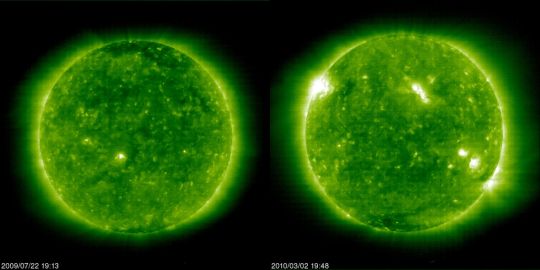
Solar activity is starting to increase again after what has been a relatively long quiet spell associated with the minimum part of the solar cycle. February was the first month in quite some time where there were sunspots every day of the month. In the image above from last July (left), the lone bright area below the equator near the center was not associated with a sunspot, but was in an area of magnetic activity.
Remember that the sun is a star, like all stars, whose business is to fuse lighter elements into heavier ones; our sun fuses hydrogen into helium. This process results in chaotic magnetic behavior of the solar plasma which fluctuates in intensity over an eleven year cycle. We wrote “Ultimate Global Warming – SPF 2 Million Won’t Be Enough” to describe the process.
Evidently, we’re on the upswing after what some scientists (real ones, not climate liars) say was a very extended inactive period, which some feared would put the sun into many years of minimal activity. It is likely that such an extended period, the Maunder Minimum, was the cause of the “Little Ice Age” during the 1600s and 1700s. We wrote “Correlating Sunspots to Global Climate” which illustrates the phenomenon using animations and graphics.
Personally, after the winter we have been having in North America this season, I will be glad to see the sunspots bring us back to our subtropical weather patterns. Old folks like warmer weather, y’know. C’mon global warming! 🙂
From the always reliable Ramirez (via Patriot Post). With the reconciliation nonsense looming, we could use a few more elephants rowing against the tide . . .

I love early spring when all the bulbs in the garden start to produce flowers. I especially like my hyacinths like this purple one that is currently in bloom in the garden. Click on the image to enlarge.

In between the rain showers today, the sun came out long enough for this bee to pollinate one of the Icelandic poppies out front of the house. Click on the image to enlarge.
