
A hundred and eleven years ago today, Orville and Wilbur Wright made their first flights from Kill Devil Hill, close to Kitty Hawk, North Carolina. Their history-making effort sparked the greatest period of technology in the United States and abroad.
I took my first flying lesson on December 16th, 1961, just a day short of their 58th anniversary. By then, the sound barrier had been broken, satellites were in orbit, the Russian, Yuri Gagarin had already orbited the Earth, and John Glenn would be in orbit within a couple of months. It was a great time to get into a career in aviation or aerospace.
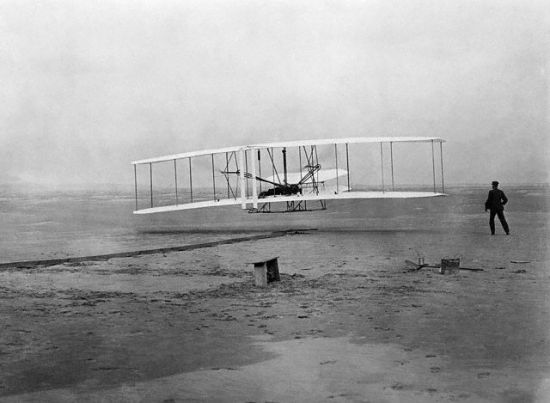
What makes Wilbur and Orville Wright’s achievement so significant is not only that it was the first time in history that a manned, powered aircraft completed a fully-controlled, sustained flight, but it proved to naysayers around the world that heavier-than-air flight was practical. After the Wrights proved their critics wrong, the field of aeronautical engineering was born. Governments, universities, and inventors soon began dedicating vast resources to understanding the science of flight and methods of building improved flying machines. In essence, every event and discovery in aviation either led up to or followed from the flight of the Wright Flyer, and it changed the way we live forever.
Image and text courtesy of AeroSpaceWeb.org.
Note: This article originally appeared here on December 17, 2007, and has been modified for the 111th anniversary of powered flight.


 This morning, the hit counter for the Never Forget Tribute rolled past ninety million. The hit counter displays an approximation of the number of times that the Tribute has been accessed since August of 2005, the date when it was made available to other websites. Knowing the exact count is virtually impossible, since we only began tracking it after it had been deployed for a couple of years. We used an extrapolation algorithm to establish the approximate count back then, and have incorporated a real-time hit counter since.


