
The March of the Penguins documentary about the Emperor Penguins in Antarctica – Awesome! Damsel and I watched the feature first and then the behind-the-scenes footage on how they shot this amazing film. The following is a comment from sam-650 via IMDB, which closely echoes our sentiments:
This is perhaps the most amazing animal documentary ever. The footage was gathered in what truly must be “the harshest place on earth”. It is barren, cold beyond cold and then there is the endless night of winter. The underwater footage was my favorite, but every single frame is magnificent. I can’t wait for the DVD, so I can see how the filmmakers did this.
The narration is less objective than it is romantic – making it less a true documentary than a story, but that is fine in this case, and Morgan Freeman does a great job. You really should make the effort to see this on the big screen – it is absolutely stunning!
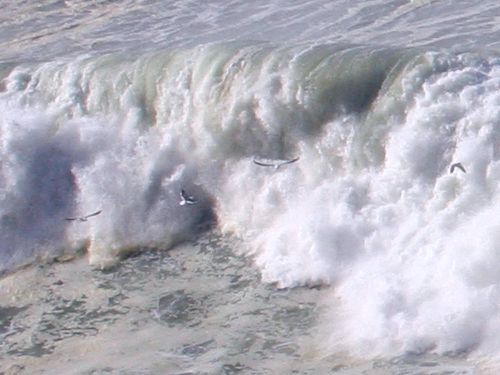
 You know it’s big surf when even the sea lions get knocked around.
 Montreal (CNSNews.com) – Former President Bill Clinton is expected to address the U.N. Climate Change Conference on Friday, the final day, after the Sierra Club reportedly raised the money to pay for Clinton’s trip.
 After sifting through seismic data from the two quakes, Valeri Korneev found a spike in the number of micro-earthquakes followed by a period of relative calm in the crust surrounding the quakes’ epicenters — months before the quakes occurred. Although more work needs to be conducted to determine whether other large quakes are foreshadowed by a similar rise and subsequent decline in small-magnitude tremors, Korneev’s analysis suggests that these peaks may be indicative of the total set of geological stresses that affect the timing and location of large earthquakes. Understanding this total stress picture may eventually make it be possible to predict destructive earthquakes within a much shorter time frame than currently possible.
 10 YEARS OF SOHO: Where would we be without SOHO? The orbiting Solar and Heliospheric Observatory (SOHO) keeps a ’round-the-clock eye on the sun and is crucial to space weather forecasting. Thousands of our readers have witnessed auroras only because SOHO spotted an incoming CME [coronal mass ejection] in time for us to issue an alert.