May 2012

Echinopsis – Easter Lily Cactus Flower

easter-lily-cactus.jpg

On our way out to walk the dogs this morning, I noticed that the echinopsis “Easter Lily” cactus flower was open. I grabbed the camera and got a picture while I could. By late morning, the flower had wilted. There are several more flower buds on the cactus, so I will be alert to get pictures of them as they open.

According to Wikipedia, echinopsis species are native to South America (Argentina, Chile, Bolivia, Peru, Brazil, Ecuador, Paraguay and Uruguay). They grow only in situations where the soil is sandy or gravelly, or on the sides of hills in the crevices of rocks. Apparently, they are OK in Arizona too, Click on the image to enlarge.

June 5, 2012 Solar Transit of Venus

Sebastian posted a bleg yesterday asking about observing the 2012 transit of Venus across the solar disk.Since I have been preparing for the annular eclipse, I posted a comment there pointing to my recent experiences with solar photography. His post got me to look up some information about the transit since we wanted to observe it here, too.

I found the NASA map of global visibility (Image courtesy of NASA) Going to the link helps you to decode the map elements (I,II,III,IV). Click on the map to enlarge.
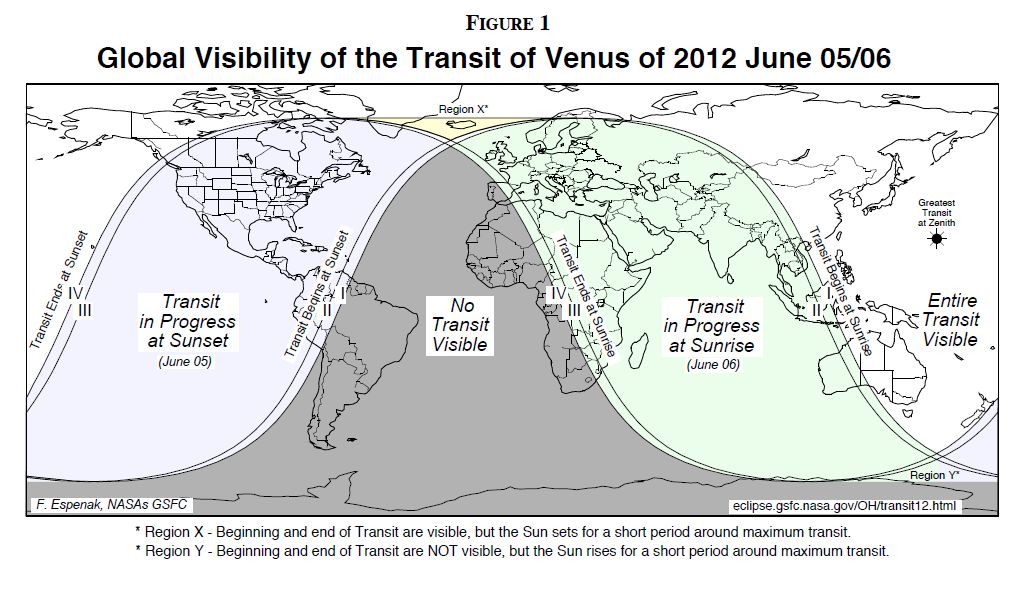
transit-map.jpg

There is a listing of transit contact events for US cities (and another for international). The closest city listed to our location is Phoenix, AZ. The first event is when the disc of Venus first touches the solar disc occurs at 15:05:55 (Arizona Time); the sun will be 54° above the horizon. The second event is when the other edge of Venus crosses the edge of the sun and occurs at 15:23:32; the sun will be at 50° of elevation. The last transit contact listed is greatest transit which, I assume, is when Venus is halfway across its path over the sun; that occurs at 19:25:24 when the sun is at 13° of elevation.

Nobody in the 48 contiguous states can witness the entire transit because it will not be over until after sundown. It will be entirely visible in Alaska and Hawaii, however.

So, I guess we will keep the eclipse shades and solar filters handy for another three weeks or so. We wouldn’t want to miss this transit since the next one will not be until December of 2117.

Pink Cholla

pink-cholla.jpg

This is a pink flower on a cholla cactus here in town. Now, we have dozens of cholla on and around our lot and none of them produce pink flowers – always orange or yellow. I’d like to get a cutting of this and plant it in a pot until it’s big enough to transplant to a place in the yard. But, this one (the only one in town?) is on a private lot. Click on the image to enlarge.

If You Can’t Take the Heat

. . . get out of the kitchen. Now that the outside temperatures are regularly above 90° and frequently above 100° (see inset in photo), I moved the baking chores to the patio. Meet my new best friend, the TOAST-R-OVEN.

oven.jpg

We prepared our meal this afternoon mostly outside; I baked three potatoes in this oven and Bob grilled steaks on the outdoor portable grill. No heat in the kitchen!

Another (BIG) Sunspot

spot-1476-1.jpg

I’m still rehearsing for the eclipse next week. Yesterday, very large sunspot 1476 was strutting its stuff across the solar plasma (still is today, I believe). I stepped out to the courtyard and captured this solar disk image using the techniques for previous solar imaging. If you look closely, you can see sunspot group 1477 above and to the left – look for a pair of slightly dark spots at about latitude 45. Click on the image for full resolution.

A Desert Bird Nest

mama-t.jpg

Springtime means more than just flowers, especially for the cholla in our front yard. It has had several flowers like the one I posted a couple of days ago. Today, I discovered that a pair of curve-billed thrashers built a nest in the cactus and there are three eggs in it (see inset in photo above). After the discovery, we went out to the courtyard to photograph one of the parents incubating the nest (since the mom & dad take turns). Click on the image to enlarge.