March 2010
Pale Blue Freesias
I bought a package of freesia bulbs a couple of years ago and planted them in a large whiskey barrel planter in the back yard. The buds began appearing a week or so ago, but today the flowers looked pretty in the morning sun.
Click on the image to enlarge.
More about freesias . . .
Freesia is a genus of about 14 species. Freesia bulbs are usually grown for use as cut flowers. All the 14 species of Freesia are African in origin.
Of The 14 Freesia species, 12 are native to Cape Province, South Africa, the remaining two to tropical Africa, with one these species extending north of the equator to Sudan. Freesia flowers are very fragrant and are typically blue, white or yellow.
The Weather Is Not Climate Issue
We have been hearing from climate alarmists lately that all this colder-than-usual winter weather is a result of global warming. In particular, winter storms and cold weather in Europe, like that which immobilized ferries and other vessels in the Baltic Sea this week. They argue that science has concluded it to be so – climate change is causing all this to happen.
Well, uh, no. It seems that even the liars at the IPCC haven’t tried to pass that crap off . . .
The winter of 2009-2010 has produced its fair share of winter storms in the Northern Hemisphere – recall that President Obama arrived back in Washington from his appearance at the Copenhagen climate conference only to find the White House grounds buried under near-record amounts of snow. Europe and Asia have seen their share of large winter storms as well during the 2009-2010 winter. Hardly a large storm goes by without someone, somewhere suggesting that whatever we are seeing, it is related to “climate change”.
If one looked no further than the Technical Summary of the IPCC, they would discover that the IPCC is rather quiet on this subject with no claims whatsoever that winter storms will increase in frequency, magnitude, duration, or intensity due to the ongoing changes in atmospheric composition. [read the rest]
Emphasis added.
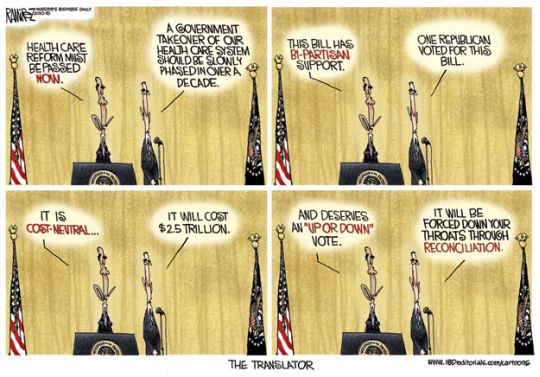
Health Care Lost In The Translation
Those of us familiar with the rhetorical obfuscation of “The One,” required no translation to know that the Democrat machine is determined to ram this crap sandwich down our throats . . .

Cute cartoon, though.
You Can’t Smell Your E-mail
From National Review Online – Charles Krauthammer’s take on the Postal Service:
I’m kind of old-school. I like the delivery. I like the snow and sleet and time of day and all of that.
Look, it’s very obvious that you can’t privatize this. Three studies have looked at the postal service. Because of the new technology there is no entrepreneur in his right mind who would purchase it. So it’s going to be on the government dole forever.
The question is, is it completely obsolete? Look, it has one mandate which other private services don’t have. It has to reach every tiny hamlet everywhere in the country no matter what. It’s got to be universal. So that’s a slight handicap that the private companies don’t have.
Its main handicap, of course, is the crushing labor union contracts and the new technology, especially e-mail, which makes most of what it does obsolete. So that’s why it runs a huge deficit.
But, look, anything that is in Article 1 Section 8 of our constitution, anything that Madison had waxed enthusiastic about it in Federalist 42 — the postal roads that have kept us together — as an old-school guy, I don’t want to see it die.
As a conservative who believes in the market, it ought to die, but as a conservative that believes in tradition and stuff that really holds us together, I would subsidize until it dies a natural death in the next generation. But for old guys like me, keep it going for a while. …
[As for] the hard-hearted younger generation — well, if you ever got a sweet-smelling love letter at 17, you’d feel otherwise. Of course, I never did, but somebody did.
You can’t smell your e-mail.

C’mon Global Warming
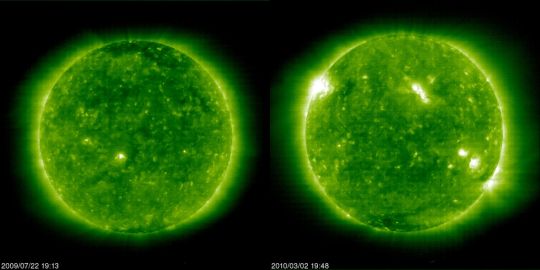
SOHO Extreme ultraviolet Imaging Telescope (EIT) solar images last summer and today:

Solar activity is starting to increase again after what has been a relatively long quiet spell associated with the minimum part of the solar cycle. February was the first month in quite some time where there were sunspots every day of the month. In the image above from last July (left), the lone bright area below the equator near the center was not associated with a sunspot, but was in an area of magnetic activity.
Remember that the sun is a star, like all stars, whose business is to fuse lighter elements into heavier ones; our sun fuses hydrogen into helium. This process results in chaotic magnetic behavior of the solar plasma which fluctuates in intensity over an eleven year cycle. We wrote “Ultimate Global Warming – SPF 2 Million Won’t Be Enough” to describe the process.
Evidently, we’re on the upswing after what some scientists (real ones, not climate liars) say was a very extended inactive period, which some feared would put the sun into many years of minimal activity. It is likely that such an extended period, the Maunder Minimum, was the cause of the “Little Ice Age” during the 1600s and 1700s. We wrote “Correlating Sunspots to Global Climate” which illustrates the phenomenon using animations and graphics.
Personally, after the winter we have been having in North America this season, I will be glad to see the sunspots bring us back to our subtropical weather patterns. Old folks like warmer weather, y’know. C’mon global warming! 🙂
I’m kind of old-school. I like the delivery. I like the snow and sleet and time of day and all of that.