Not to detract from the lovely and priceless art of Leonardo da Vinci, but these Mona Lisa roses give the famous painting in the Louvre a run for the money.
Happy Mothers Day!

Click on Mona to enlarge.

Not to detract from the lovely and priceless art of Leonardo da Vinci, but these Mona Lisa roses give the famous painting in the Louvre a run for the money.
Happy Mothers Day!
Click on Mona to enlarge.
 This is Gazania, or ‘Treasure Flower.’ Gazania is a South African perennial that looks similar to a daisy, but in bold, brilliant yellows, oranges, reds, pinks, cream and even a beautiful mauve and a burgundy color. It’s a plant that is perfect for window boxes or any hot, dry and sunny spot.
Gazania grows well in rock gardens or in hot, dry areas. Good soil gives best growth but the plant tolerates poor, sandy soil. Gazania requires less water than most annuals. Full sun is preferred and the flowers do not open on wet or cloudy days.
This one was open on the patio this morning just after I watered. Click the image above for the big picture.
The following has been excerpted from World Climate Report. Using the ‘magic number’ they developed with exhaustive back of the envelope calculations, they have arrived at a way that you, as a ‘polluter,’ can actually see to what extent you are causing (or ‘preventing’) temperature change.
Of course, this assumes that the Sun has little or nothing to do with climate change. Click on the link below if you want to see WCR’s complete analysis.
“What You Can(‘t) Do About Global Warming”
This is a handy-dandy and powerful piece of information to have, because now, whenever you are presented with an emissions savings that some action to save the planet from global warming is supposed to produce, you can actually see how much of a difference it will really make. Just take the emissions savings (in units of million metric tonnes (mmt) of CO2) and divide it by 1,767,250.
We are always hearing about ways that you can “save the planet” from the perils of global warming—from riding your bicycle to work, to supporting the latest national greenhouse gas restriction limitations, and everything in between.
In virtually each and every case, advocates of these measures provide you with the amount of greenhouse gas emissions (primarily carbon dioxide) that will be saved by the particular action.
And if you want to figure this out for yourself, the web is full of CO2 calculators (just google “CO2 calculator”) which allow you to calculate your carbon footprint and how much it can be reduced by taking various conservations steps—all with an eye towards reducing global warming.
However, in absolutely zero of these cases are you told, or can you calculate, how much impact you are going to have on the actual climate itself. After all, CO2 emissions are not climate—they are gases. Climate is temperature and precipitation and storms and winds, etc. If the goal of the actions is to prevent global warming, then you shouldn’t really care a hoot about the amount of CO2 emissions that you are reducing, but instead, you want to know how much of the planet you are saving. How much anthropogenic climate change is being prevented by unplugging your cell phone charger, from biking to the park, or from slashing national carbon dioxide emissions?
Why do none of the CO2 calculators give you that most valuable piece of information? Why don’t the politicians, the EPA, and/or greenhouse gas reduction advocates tell you the bottom line?
How much global warming are we avoiding?
Embarrassingly for them, this information is readily available.
Let’s say that you decide to stop driving your SUV for a year. According to NativeEnergy.com, you would circumvent causing 24 metric tons of emissions.
Wow! That’s a lot!
Now, let’s do the magic number thing. First, convert 24 metric tons in terms of million metric tons = 0.000024 mmt. Divide that by 1,767,250 = 0.0000000000136°C/year.
If you lack the fortitude to actually make these sacrifices to prevent one hundred billionth of a degree of warming, for $364 each year, NativeEnergy.com will offset your guilt.
Talk about Ponzi schemes . . .
Given the draconian Waxman–Markey bill before the House of Representatives, this magic number will show just how little carbon caps will help. Just consider how devastating to the economy these Congressional Ponzi schemes will be if the bill passes.
See “The Waxman-Markey ‘Climate’ Bill Does Nothing for the Climate“
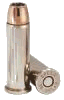 This same issue seems to come back year after year – introduced by the same people and hopefully receiving the same disposition – to die in committee.
Last year, State Assembly Member Kevin De Leon (D-45), introduced Assembly Bill 2062 which put ammunition sales in the crosshairs. AB2062 would have required that law-abiding gun owners obtain a permit to buy handgun ammunition and would have imposed severe restrictions on the private transfers of handgun ammunition. Thankfully, it died in committee.
De Leon’s latest craziness again hit a speed bump in committee – from NRA-ILA:
Today, Assembly Bill 962 was placed in the suspense file by the Assembly Committee on Appropriations.
Sponsored by Assembly Member Kevin De Leon (D-45), AB962 would make it a crime to privately transfer more than 50 rounds of ammunition per month, even between family and friends, unless you are registered as a “handgun ammunition vendor” in the Department of Justice’s database. Ammunition retailers would have to be licensed and store ammunition in such a manner that it would be inaccessible to purchasers. The bill would also require purchasers submit to fingerprinting, which would be submitted to the Department of Justice. Lastly, mail order ammunition sales would be prohibited.
While this development is a solid step towards defeating AB962, the bill still poses a threat.
Not that we have any hope of ever getting rid of De Leon, or the Democrats that propose these insane ideas, but a trend may be in the works toward more sensible politics when it comes to firearms issues.
Week after week, we put up our silhouette targets and try to shoot them down with our Remingtons.
Before this video starts, Damsel has already put some 20 gauge rounds through the center of the target. My turn came up and I used the 12 gauge to cut the right side of the target away from the top. I reloaded and Damsel stepped to my left side to capture the next two shots which finalized the separation.
Sometimes it takes more shots to get the job done, although we both have cut these targets in half with only five rounds. I think you have to get lucky for that to happen, but it does once in a while.
We didn’t shoot last weekend, mainly because ammunition is in short supply and we’re hoarding ours – like everyone else – until the supply side starts catching up with the demand again. So, we rely on our video therapy for now.
This is the latest addition to the living room decor. It’s a miniature ‘Moth Orchid’ or phalaenopsis. The colors range from pinks to yellows to greens with a pattern of tiny maroon stripes and dots. There are three flowers on the stem with more to come. I think it’s very beautiful. Click on the image to enlarge.

 Cruise ships normally destined for sunny Mexico are diverting to Santa Catalina Island to avoid possible exposure to the Swine Influenza Virus at Mexican ports like Ensenada and Puerto Vallarta. Cruise ship traffic to the island is normally three to five ships a week, depending on the season.
Through May, the island now expects 25 cruise ship calls, possibly more. With one ship in the harbor, it is our personal experience that the foot traffic in town and the island’s attractions become quite busy. Now, according to the Catalina Island Company, there are likely to be several more instances of two ships in the harbor at the same time.
Image: a 2005 photo of Avalon Bay taken from Island Express Helicopter.
Our anniversary is in September and, as usual, we’re booked in to the Hotel Metropole. We hope that the rush is over by then.