August 2007

Time To Thin Out The Herd

Drop your X-box and grab your sox – uh, no, wait . . . maybe you could grab your favorite fuzzy Ugs instead . . . it’s time to pimp your favorite whacko candidate.

alka-paul-ics.jpgSeen recently in Southern California, this pair of Ron Paul supporters gave up their super-sizers, X-boxes and the comfort of Mom’s basement to venture out among the masses and promote their candidate.

The results of Saturday’s Iowa straw poll would indicate that Paul, along with McCain, Tancredo, Cox and Hunter, ought to follow Tommy Thompson’s lead and remove some more of the ‘noise’ from the Republican campaign.

The Iowa results:

1. Mitt Romney – 4516 votes, 31%
2. Mike Huckabee – 2587 votes, 18.1%
3. Sam Brownback – 2192 votes, 15.3%
4. Tom Tancredo – 1961 votes, 13.7%
5. Ron Paul – 1305 votes, 9.1%
6. Tommy Thompson – 1,009 votes, 7.3%
7. Fred Thompson – 231 votes
8. Rudy Giuliani – 183 votes
9. Duncan Hunter – 174 votes
10. John McCain – 101 votes
11. John Cox – 41 votes

Photo credit Damsel – taken July 26, 2007 in Chula Vista, CA. Also credit Damsel with the ‘Mom’s Basement’ and ‘game-playing nerds’ observation.
Golden Butterfly

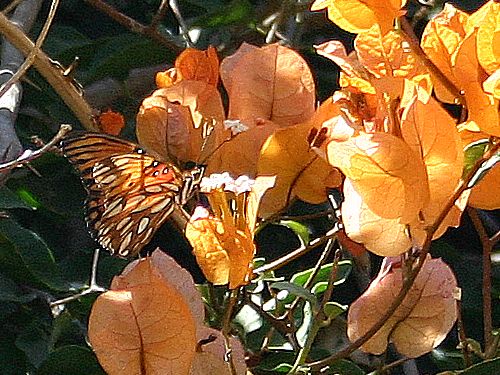
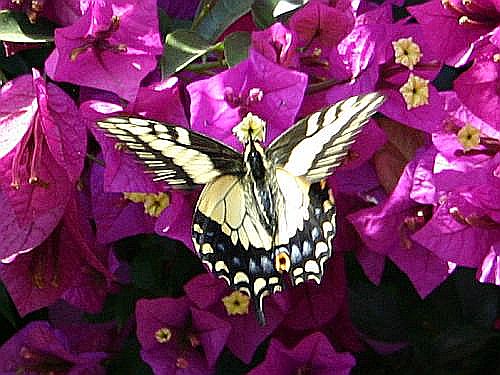
It’s been a weekend for butterflies in our back yard. Unlike yesterday’s yellow butterfly on purple petals, this golden butterfly among golden petals was a bit more difficult to spot. This is a good example of natural camouflage if I’ve ever seen it.

golden-butterfly.jpg

Tick Tock Tick Tock Tick Tock . . .

glock-26.gifThat’s the sound of the ridiculous 10-day California waiting-period clock when you purchase a firearm. Background checks are practically instantaneous these days and the database for determining the suitability of a gun purchaser is virtually available twenty-four/seven.

Knowing that it takes far less than ten days to get this information can only mean that the ultra-liberal California nanny-state legislature is targeting the legitimate firearms enthusiast with a punitive delay harassment. I’m sure the underground firearms trade in the state have no such rules. Who is actually getting punished? Law-abiding gun purchasers and dealers! What a bunch of crap!

OK – there now that I’ve got that off my chest, I’m pleased to report that there are now less than the original 864,000 waiting period ticks left until I take possession of my newly-purchased (but yet to be acquired) Glock 26 9mm subcompact pistol. Ever since Damsel got her pocket-sized shooter, I’ve had a hankering for a little pistol. Last week, we took one of these for a test drive and liked it, so today we made the deal and started the wait. Click on the thumbnail above for a larger view of this neat little gun.

Solar Spicules

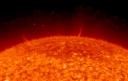
Huge spikes of plasma fly out of the Sun’s surface all the time, according to scientists studying observations made by SOHO and STEREO spacecraft. This week’s SOHO Pick of the Week discusses these spikes in scientific terms, although there is still considerable question as to their nature and effects, especially about how they affect the planets — ours in particular.

I’m thankful for the ongoing study of the Sun. The more we learn about it, the more we will be able to refute the hysterical Greenbat nonsense about man-made global warming .

Breaking News! James Hansen’s Fake Temperature Algorithms

From SOHO Pick of the Week:

spiculesA close up view of the top of the Sun as seen in profile shows thousands of little spurts, like small blow torches, shooting out all over the Sun. The movie shows just an average day’s worth of this kind of activity as seen from the STEREO spacecraft (Ahead) in extreme ultraviolet light (August 3, 2007). These spurts are called spicules. With STEREO’s 2048×2048 image resolution and an image every 10 minutes, we can zoom in on features like this with no distortion. Spicules are plasma jets that shoot through the Sun’s atmosphere or corona at about 90,000 kilometers per hour. Discovered in 1877 by Angelo Secchi, they remain largely unexplained, in part because observations are difficult for objects with a brief life (about 5 minutes) and relatively small size (diameters of just 300 miles / 500 kilometers). They are caused by shock waves formed when sound waves at the solar surface leak into the solar atmosphere. More than 100,000 spicules occur at any given time on our star’s surface.
Watch the video below for a dynamic look at Solar Spicules.

Continue reading…

Sunflower Centerpiece

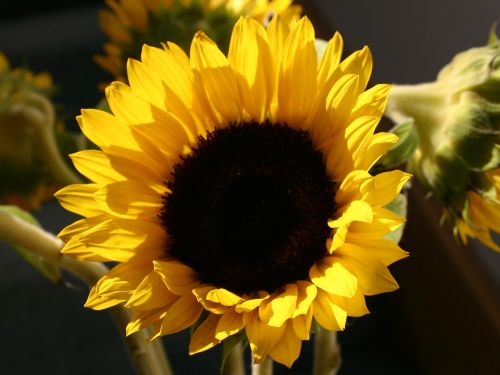
This week these sunflowers have been decorating our living room. At a certain time each morning (if the clouds are gone) they are bathed in the sunlight – great for taking their pictures!

sunflower

Large Exoplanet Discovered by Lowell Astronomers

tres-4.jpgFor several years, Damsel and I have been contributing members of Lowell Observatory on Mars Hill near Flagstaff, Arizona. We occasionally visit them and always enjoy the museum and tours.

Recently, Lowell Astronomers made a discovery of a very large, but low-density planet, orbiting a distant star. The planet should be smaller and more compact, according to physics, but it is a nebulous, oversized lightweight ball.

Image above courtesy Lowell Observatory: Artist conception of TrES-4 and it’s host star. Click on the thumbnail image to view the high-resolution artwork.

From Lowell Observatory:

FOR IMMEDIATE RELEASE

August 6, 2007

Largest Transiting Extrasolar Planet Found Around A Distant Star

Flagstaff, Ariz.– An international team of astronomers with the Trans-atlantic Exoplanet Survey announce today the discovery of TrES-4, a new extrasolar planet in the constellation of Hercules. The new planet was identified by astronomers looking for transiting planets – that is, planets that pass in front of their home star – using a network of small automated telescopes in Arizona, California, and the Canary Islands. TrES-4 was discovered less than half a degree (about the size of the full Moon) from the team’s third planet, TrES-3.

“TrES-4 is the largest known exoplanet,” said Georgi Mandushev, Lowell Observatory astronomer and the lead author of the paper announcing the discovery. “It is about 70 percent bigger than Jupiter, the Solar System’s largest planet, but less massive, making it a planet of extremely low density. Its mean density is only about 0.2 grams per cubic centimeter, or about the density of balsa wood! And because of the planet’s relatively weak pull on its upper atmosphere, some of the atmosphere probably escapes in a comet-like tail.”

Continue reading…