
A Russian communications satellite in geostationary orbit has apparently taken an “exceptionally rare” meteor impact. The spacecraft’s thermal control system malfunctioned as a result and prompted an attempt by ground controllers to deorbit the spacecraft. Were the satellite to completely fail on station causing the deorbit attempt to be unsuccessful, the residual “space junk” would render a valuable segment of geostationary orbit unusable for re-use for an indeterminate period of time. Available “slots” in the geostationary band are few these days due to high demand.
Don’t think that this is exclusively the Russians’ problem, since many western commercial and military interests vie for slots which are internationally allocated – for military applications, slots are required in view of every location on Earth. For technical reasons (beamwidth and selectivity), geostationary satellites can not be placed at intervals closer than every few degrees. This fact limits the number of satellites that may occupy slots in a thin band of space defined as exactly a specific geostationary distance from the planet and exactly over the equator.
From New Scientist:
Impact suspected for loss of Russian satellite
A Russian communications satellite appears to have been struck by “a sudden external impact”. Its operators say the extent of the damage caused means the satellite will be sent into “space disposal orbit”.
The Russian Satellite Communications Company’s (RSCC) Express-AM11 satellite ran into its trouble at 0341 Moscow time (0041 GMT) on 29 March. Telemetry from the craft indicates that the fluid circuit that is part of the satellite’s thermal control system depressurised very rapidly. Such damage leaves the spacecraft unable to prevent fluctuations in temperature that can cause electronics to fail.
An RSCC statement says that the satellite’s manufacturer, NPO-PM in Krasnoyarsky Krai, Russia, believes the depressurisation was triggered by an external impact on the spacecraft.
 In the US, DST was used during the first and second world wars to (ostensibly) conserve energy; during WWII it was referred to as “war time.” DST has value in temperate zones where the daylight to darkness ratio changes considerably from summer to winter. This allows for the human sleep/awake cycle to generally align better with darkness/daylight. The intended effect is less energy consumption. There are some
  Sacramento Bee:
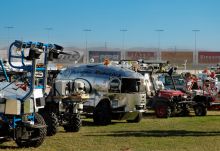 Join NOVA for an exclusive backstage pass to the DARPA Grand Challenge—a raucous race for robotic, driverless vehicles sponsored by the Pentagon, which awards a $2 million purse to the winning team. Armed with artificial intelligence, laser-guided vision, GPS navigation, and 3-D mapping systems, the contenders are some of the world’s most advanced robots. Yet even their formidable technology and mechanical prowess may not be enough to overcome the grueling 130-mile course through Nevada’s desert terrain. From concept to construction to the final competition, “The Great Robot Race” delivers the absorbing inside story of clever engineers and their unyielding drive to create a champion, capturing the only aerial footage that exists of the Grand Challenge.
 There is not much new in a collection of articles about global warming and sea level rise in the latest issue of Science. As such, it is mostly recycled and repackaged information that the head of the American Association for the Advancement of Science (AAAS), Donald Kennedy, can take down from New York Avenue in DC to Capitol Hill, to scare politicians into doing what it wants, which is an immediate cap on U.S. emissions of carbon dioxide.