Happy Fat Tuesday!

John Hinderaker at PowerLine found more evidence of science tampering with the numbers in order to get the results that support their political position. One of the issues is Global Warming.
This is a good read: Power Line: A Bad Mix
Carnival (a farewell to meat) is defined as a communal celebration, especially the religious celebration in Catholic countries that takes place just before Lent. Since early times carnivals have been accompanied by parades, masquerades, pageants, and other forms of revelry that had their origins in pre-Christian pagan rites, particularly fertility rites that were connected with the coming of spring and the rebirth of vegetation.
 One of the first recorded instances of an annual spring festival is the festival of Osiris in Egypt; it commemorated the renewal of life brought about by the yearly flooding of the Nile. In Athens, during the 6th century B.C., a yearly celebration in honor of the god Dionysus was the first recorded instance of the use of a float. It was during the Roman Empire that carnivals reached an unparalleled peak of civil disorder and licentiousness. The major Roman carnivals were the Bacchanalia, the Saturnalia, and the Lupercalia.
Image: a peacock-feathered Carnival mask – credit: Damsel
In Europe the tradition of spring fertility celebrations persisted well into Christian times, where carnivals reached their peak during the 14th and 15th cent. Because carnivals are deeply rooted in pagan superstitions and the folklore of Europe, the Roman Catholic Church was unable to stamp them out and finally accepted many of them as part of church activity. The immediate consequence of church influence may be seen in the medieval Feast of Fools, which included a mock Mass and a blasphemous impersonation of church officials. Eventually, however, the power of the church made itself felt, and the carnival was stripped of its most offending elements. The church succeeded in dominating the activities of the carnivals, and eventually they became directly related to the coming of Lent. The major celebrations are generally on Shrove Tuesday or “Fat” Tuesday (Mardi Gras).
 When disaster strikes, our support goes to the Salvation Army. Actually, we support them even when there’s not an emergency. Local citadels do a lot of good in our communities for adult rehabilitation and other community services.
After September 11, 2001, and in the wake of the terrible 2005 Hurricanes, the American Red Cross seems to have missed their charter, and entertain “perks” and other nonsense. We’re turned off from them for the time being.
This is a part of an article that Captain Ed posted today:
Red Cross Donations Go To Celebrity Parties
When people donate to the Red Cross, as I have in the past, they expect their money to go to disaster relief or to supporting blood drives, not to get their executives high-paying speaking gigs or to allow them to rub elbows with Hollywood celebrities. This amounts to an abuse and deception on the part of the Red Cross, gaining donations — especially in the wake of 9/11 and recently with Hurricane Katrina — by using the pain and suffering of victims in order to support a glamorous work environment. As Harvard lecturer Peter Dobkin Hall notes, the Red Cross doesn’t need to spend money to raise awareness of the organization, as people “throw money” at them whenever disaster strikes.
. . . as of last night, that was the “official population” of our planet. And they say it will keep growing and growing.
From LiveScience.com:
Planet’s Population to Hit 6.5 Billion Saturday
A population milestone is about to be set on this jam-packed planet.
On Saturday, Feb. 25, at 7:16 p.m. Eastern Standard Time, the population here on this good Earth is projected to hit 6.5 billion people.
Along with this forecast, an analysis by the International Programs Center at the U.S. Census Bureau points to another factoid, Robert Bernstein of the Bureau’s Public Information Center advised LiveScience. Mark this on your calendar: Some six years from now, on Oct. 18, 2012 at 4:36 p.m. Eastern Daylight Time, the Earth will be home to 7 billion folks.
[ . . . ]
Remarkably, despite the many new developments over the past 50 years, one fact looks very much the same, explained Kent and Haub: Populations are growing most rapidly where such growth can be afforded the least—an observation that has changed little over time, they said.
That last thought is the most frightening. This means that the most backwards places on the planet will continue to produce, indoctrinate, and deliver more and more American hating people into the population.
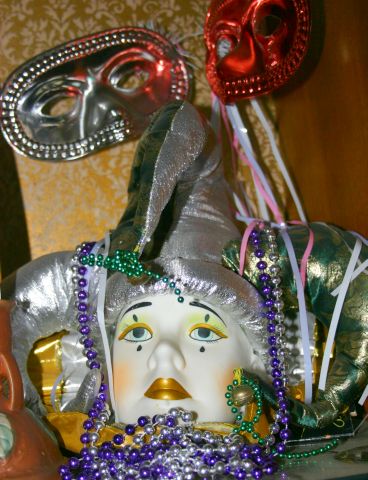
Or, “Laissez les Bon Temps Roulez” as they say in the French Quarter when Mardi Gras is in progress. When we hosted our wedding reception, the Cap’n and I used this lovely Harlequin doll and a number of other Mardi Gras props and used that theme for the party. It was wonderful. So, we wish you and revelers everywhere a happy Fat Tuesday!

I have more Mardi Gras props and decorations, so I promise to get some more pictures up soon.
Lily von Stupf from “Blazing Saddles” said that. Whatever . . .
However, this is a very nice picture I took of one of a half-dozen red rosebuds I got today.